
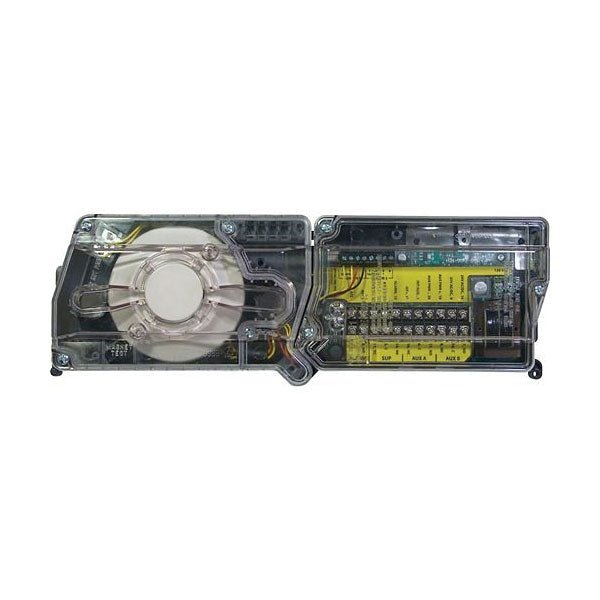
Choose by how the detector reports. The DNR, DNRW and Fire-Lite D365PL are addressable housings powered from the panel's signaling line circuit. The D4120 is a 4-wire conventional detector with its own fan-shutdown relays. The D2 is a 2-wire conventional detector for a compatible initiating zone.
Every one of them needs a sampling tube sized to the duct, ordered separately, and most jobs add a remote test station. The tables below match each detector to its sensor head, test station and tube, using the manufacturers' data sheets and installation instructions.
What is the difference between DNR, DNRW, D4120, D2 and D365PL?
| Model | Type | Power | Sensor head | Relays |
|---|---|---|---|---|
| DNR | Addressable, non-relay housing | SLC only | Sold separately | None. Space in the housing for a relay module |
| DNRW | Same as DNR in a watertight NEMA 4 housing | SLC only | Sold separately | None |
| Fire-Lite D365PL | Addressable, non-relay | SLC, 15 to 32 VDC | SD365R-IV, factory installed | None |
| D4120 | 4-wire conventional | 20 to 29 VDC, 24 VAC or 120 VAC | 2D51 plug-in head | Two DPDT Form C auxiliary relays, an alarm initiation contact and a supervisory contact |
| D2 | 2-wire conventional | 8.5 to 35 VDC from the initiating circuit | 2151 plug-in head | None |
All five are InnovairFlex photoelectric detectors rated for air velocities of 100 to 4,000 ft/min and duct temperatures of -4 to 158°F (the D365PL drops to 32 to 120°F when a module is installed in its housing), in a housing that pivots between a rectangular and a square footprint.
- D4120. The detector is made of two components that are also sold separately: the D4P120 power board and the D4S sensor. One power board can monitor a second D4S, for supply and return, and up to 50 detectors can be interconnected for multiple fan shutdown. System Sensor states it is not designed for 2-wire applications.
- D2. It draws power from the zone, so it has to be on a listed compatible 2-wire panel, with the end-of-line resistor the panel manufacturer specifies.
- DNR and DNRW. They communicate on the SLC and take the addressable photoelectric head of the panel brand. For fan control the data sheet has you add a relay module in the housing.
Which sensor head does each housing take, and is it included?
Only the DNR and DNRW ship without a head. Order the remote-test-capable ("R") head that belongs to your panel's protocol: for Fire-Lite panels that is the SD365R or SD365R-IV, which Fire-Lite lists for use inside DNR and DNRW housings. For other brands, take the head part number from that brand's DNR data sheet or the panel's compatibility document, because a head that does not speak the panel's protocol will not work.
The D365PL arrives with an SD365R-IV installed. The D4120 uses the 2D51 and the D2 uses the 2151; both manuals give those numbers for sensor replacement.
What replaces the Fire-Lite D355PL?
The store lists the D365PL as the replacement for the D355PL. The Fire-Lite documents we read confirm what changed but do not state the supersession in so many words: the D355PL data sheet shows it shipped with an SD355R head, and the D365PL instructions show an SD365R-IV. Fire-Lite states the SD365R-IV supports LiteSpeed or CLIP mode, while the plain SD365R supports LiteSpeed only. Check your panel's Device Compatibility Document before ordering.
Which remote test station works with which duct detector?
| Detector | Test station named in its documents | Conditions |
|---|---|---|
| DNR, DNRW | RTS151, RTS151KEY | Needs a remote-test-capable head. Fire-Lite's sheet says DNRW housings with date code 0013 or higher need no test coil or auxiliary 24 VDC; earlier ones need the DCOIL and 24 VDC |
| D365PL | RTS151, RTS151KEY | Listed as optional accessories with the RA100Z remote LED |
| D4120 | RTS151, RTS151KEY, RTS2, RTS2-AOS | The RTS151 can also reset the detector |
| D2 | RTS451, RTS451KEY in the manual we read | Requires the DCOIL accessory coil. Confirm the current station model against the sheet packed with the detector |
The RTS2 and RTS2-AOS are for InnovairFlex 4-wire conventional detectors only. One unit shows the status of up to two sensors, tests the selected one and resets both. The RTS2-AOS adds a strobe. Either can be mounted up to 1,000 ft from the detector.
Which sampling tube length fits my duct width?
System Sensor's table goes by outside duct width:
| Outside duct width | Sampling tube |
|---|---|
| Up to 1 ft | DST1 |
| 1 to 2 ft | DST1.5 |
| 2 to 4 ft | DST3 |
| 4 to 8 ft | DST5 |
| 8 to 12 ft | DST10 (two-piece) |
The tube is not in the detector box. What is included is the end cap, which the manual calls critical to proper operation, and a plastic exhaust tube. Install the tube with the inlet holes facing into the airflow. Each manual states the minimum distance the tube must reach across the duct, and they are not all the same, so read the one for your model. The DST tubes are for InnovairFlex detectors.
What are the Simplex and Edwards equivalents?
They are separate product families with their own heads, tubes and test stations. System Sensor DST tubes and RTS stations do not appear in their documents.
| Model | What it is | Accessories in the manufacturer's data sheet |
|---|---|---|
| Simplex 4098-9755 | Addressable TrueAlarm duct housing with no relay output, powered by IDNet or MAPNET II communications. 4098-9714 sensor included | Sampling tubes 4098-9854 to 4098-9858; 2098-9806 test station; 2098-9808 remote LED |
| Simplex 4098-9756 | The same housing with a supervised output for remote relays. Requires separate 24 VDC and a 4081-9008 end-of-line resistor harness; one 4098-9843 relay included, up to 15 supported | Same tubes and stations |
| Edwards SIGA-SD | Signature Series addressable duct detector with an integral photoelectric sensor and one Form C auxiliary relay | SD-T8 to SD-T120 sampling tubes; SD-TRK (keyed) and SD-TRM (magnetic) test stations |
So "2-wire" and "4-wire" on the Simplex housings describe whether a separate 24 VDC feed is needed. Both are addressable and work only on the Simplex panels the data sheet lists. Simplex rates them for 300 to 4,000 ft/min.
The store stocks duct detectors, remote test stations and sampling tubes; in-stock orders placed by 3 PM ET ship the same business day. Confirm the detector and head against the control panel's listing documents, and follow NFPA 72 and your local AHJ. Where duct detection is required is set by the mechanical code and NFPA 90A as adopted locally. For a project list, request a quote.
Sources
- Honeywell (Gamewell-FCI), InnovairFlex DNR/DNRW Duct Smoke Housing data sheet (9021-60475): prod-edam.honeywell.com/.../9021-60475.pdf
- Honeywell (Gamewell-FCI), InnovairFlex D4120 Duct Smoke Detector data sheet (9021-60470): prod-edam.honeywell.com/.../9021-60470.pdf
- System Sensor, D4120, D4S and D4P120 Installation and Maintenance Instructions (I56-2967): prod-edam.honeywell.com/.../D4120_Manual_I56-2967.pdf
- System Sensor, D2 Duct Smoke Detector Installation and Maintenance Instructions (I56-3050): prod-edam.honeywell.com/.../I56-3050-001R.pdf
- System Sensor, RTS2, RTS2-AOS Multi-Signaling Accessory manual (I56-3381): prod-edam.honeywell.com/.../RTS-AOS_Manual_I56-3381.pdf
- Fire-Lite, D355PL(A)/DNRW data sheet (DF-60430): prod-edam.honeywell.com/.../df-60430.pdf
- Fire-Lite, D365PL Duct Smoke Detector Installation and Maintenance Instructions (I56-6626), copy hosted by a distributor: sdilink.com/Specsheet/d365pluser.pdf
- Fire-Lite, SD365R and SD365R-IV Installation and Maintenance Instructions (I56-6524): prod-edam.honeywell.com/.../I56-6524.pdf
- Simplex, Addressable Duct Sensor Housings with TrueAlarm Photoelectric Sensor data sheet (S4098-0030): docs.johnsoncontrols.com/simplex/.../9nV823vah63qrU2BRu~aQg/content
- Edwards (GE Security / EST), SIGA-SD Intelligent SuperDuct Detector data sheet (85001-0584), copy hosted by a distributor: steelfire.com/UserFiles/Docs/SIGA-SD.pdf