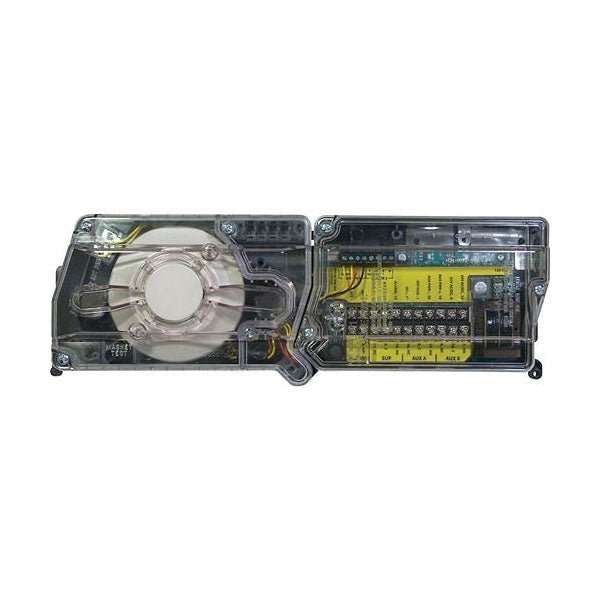
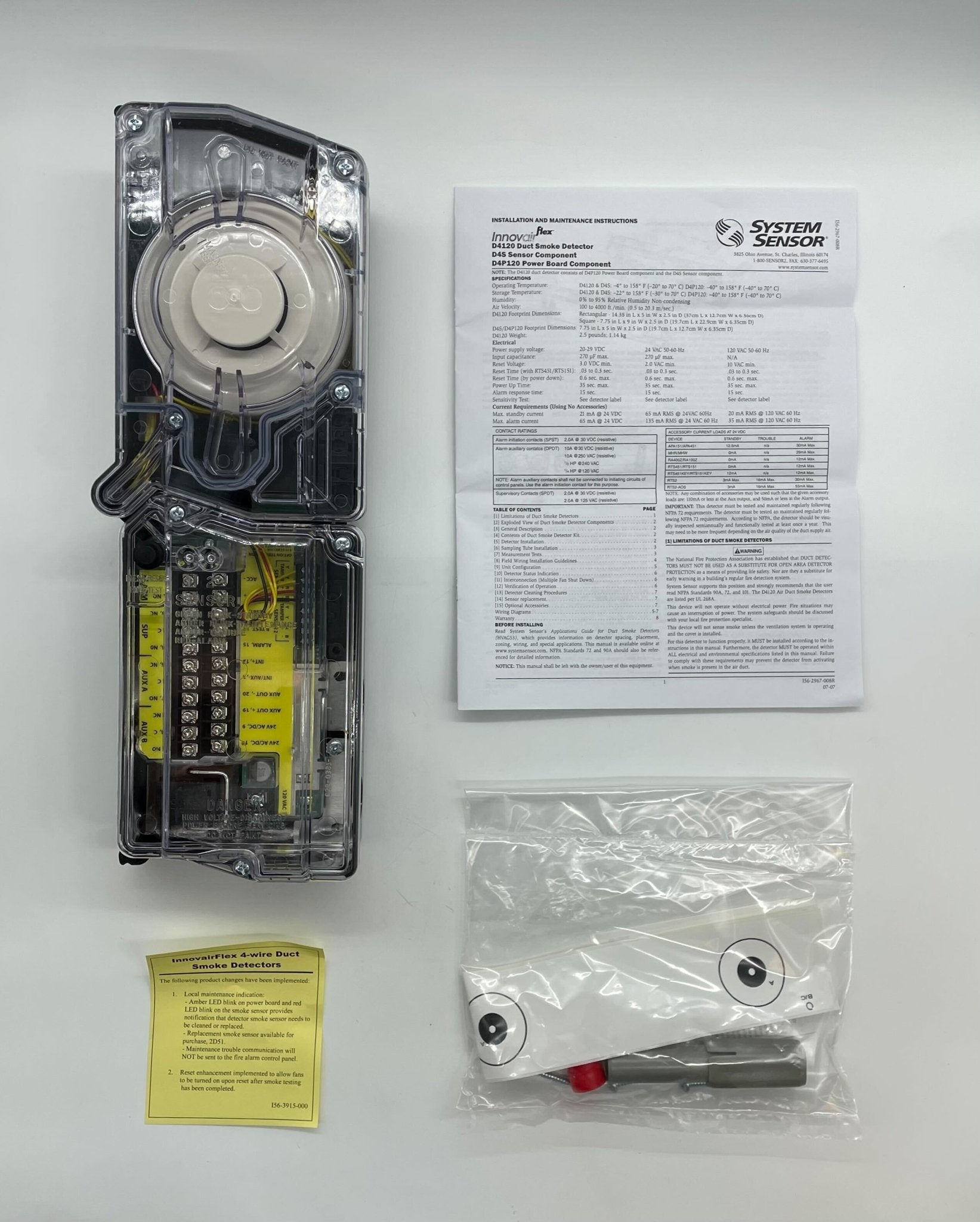
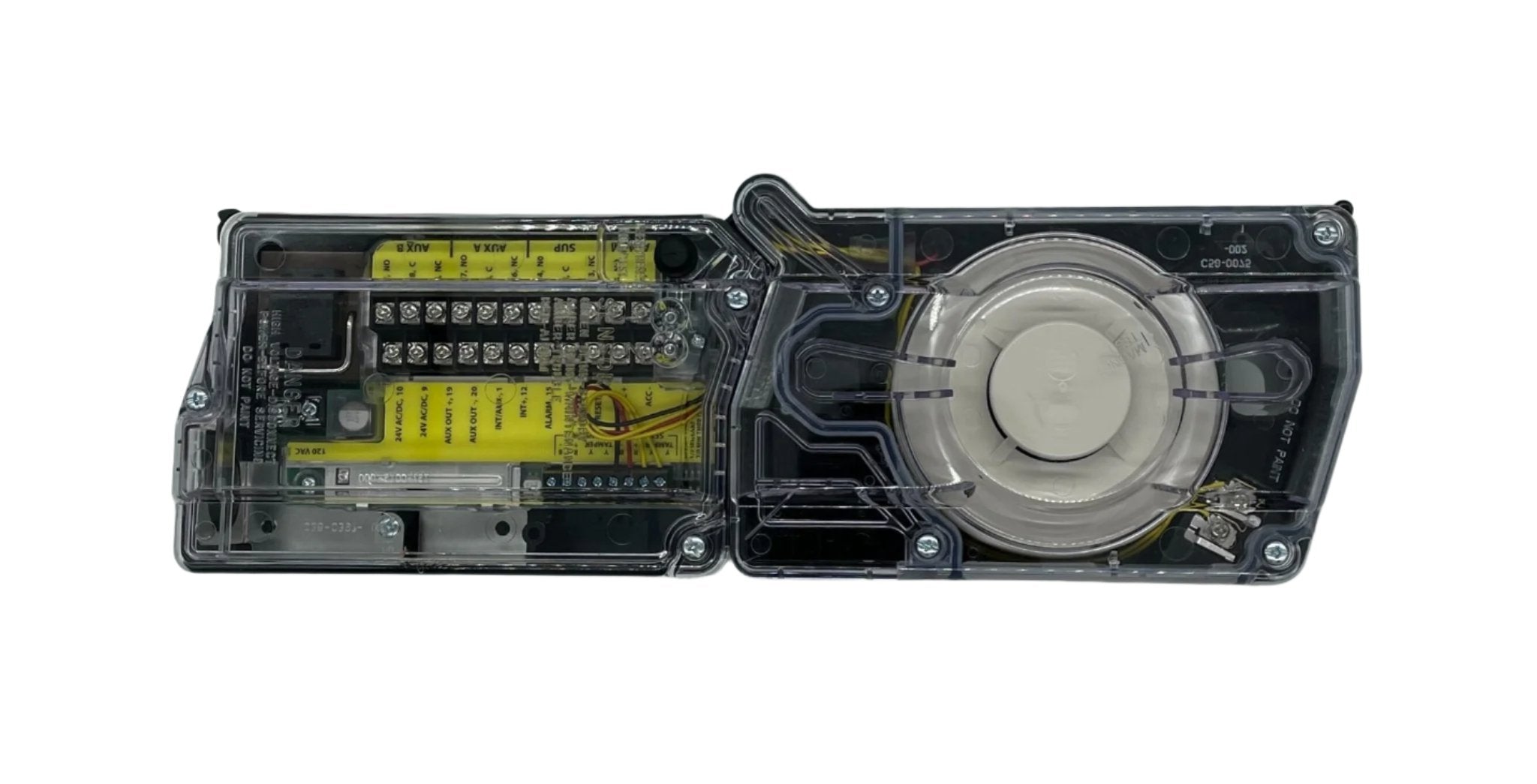
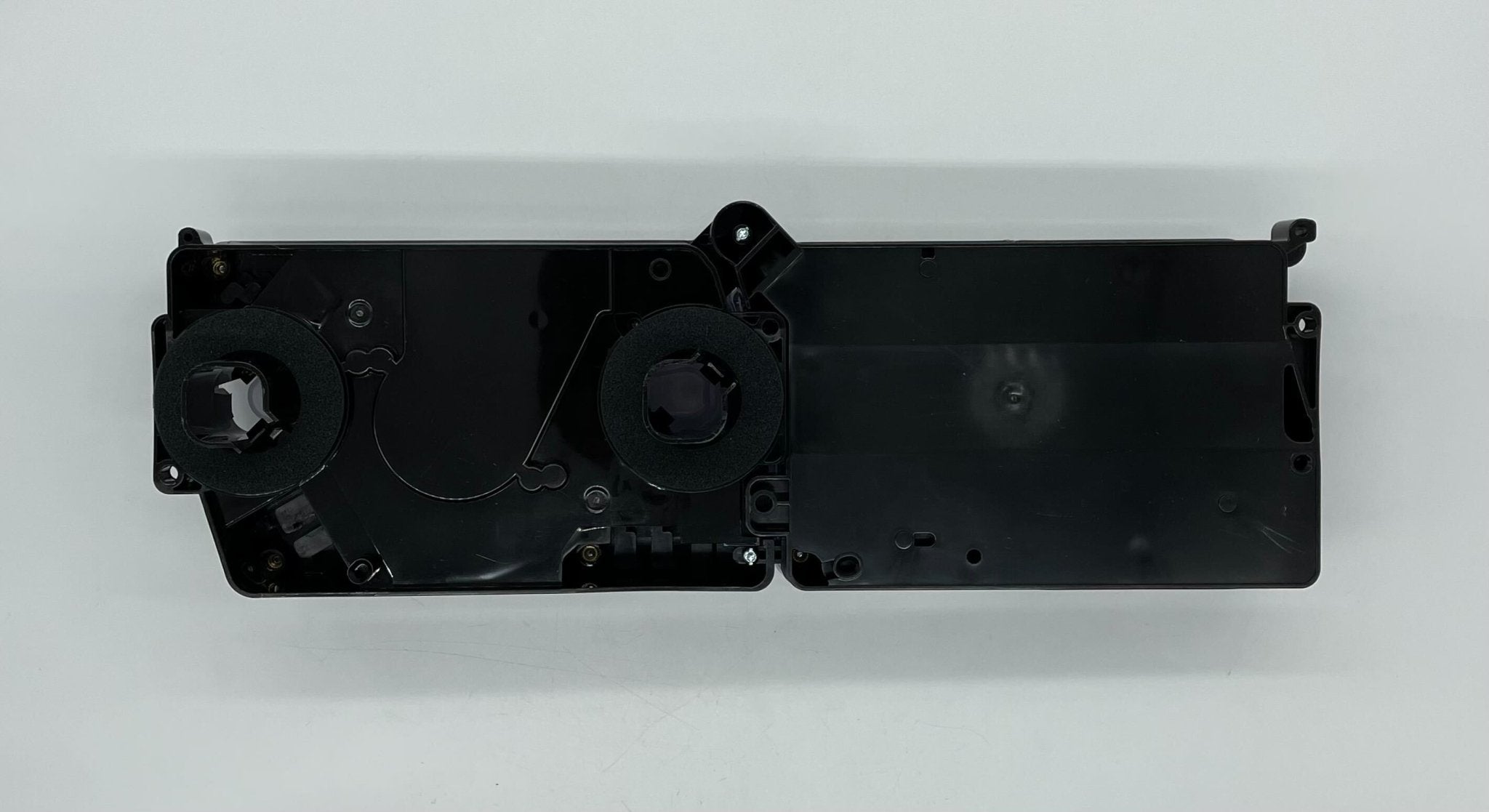
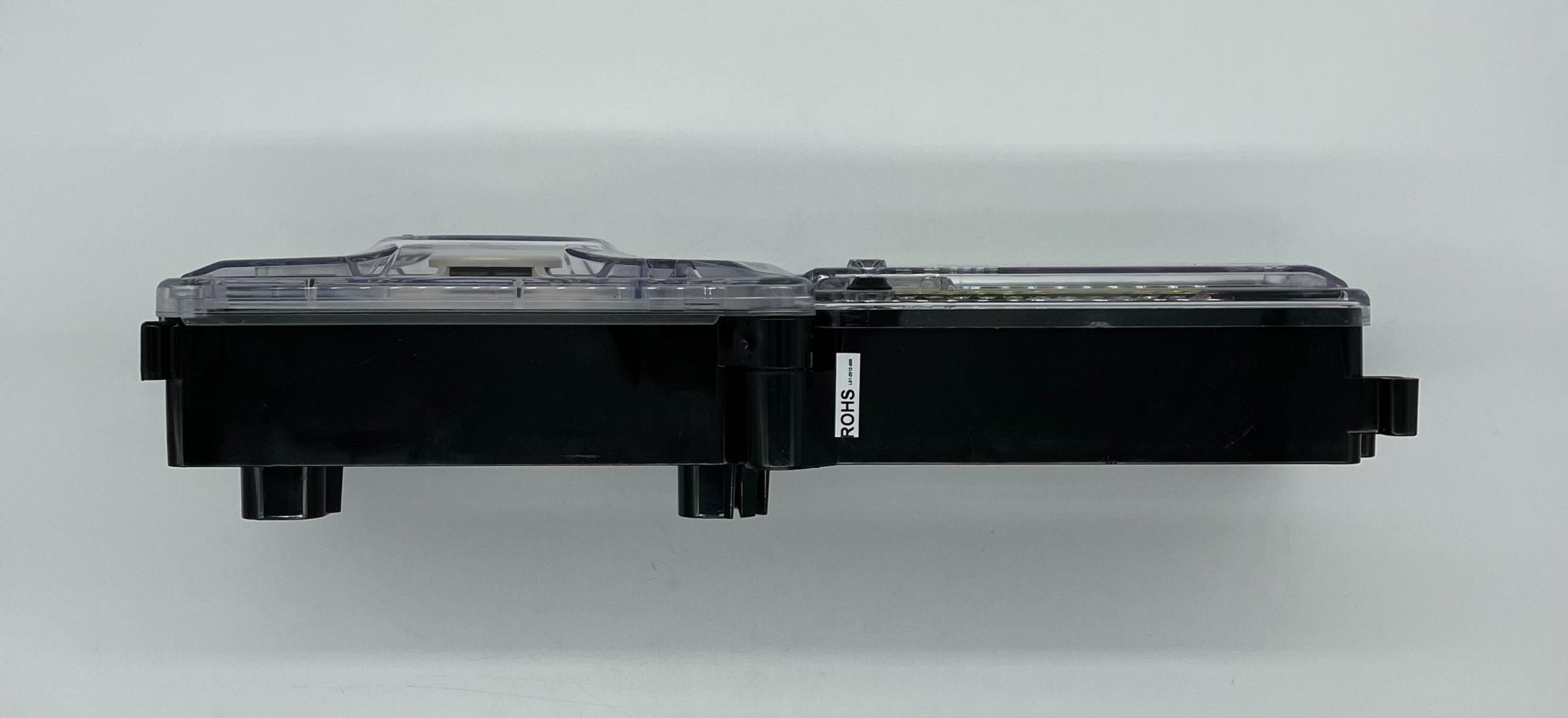
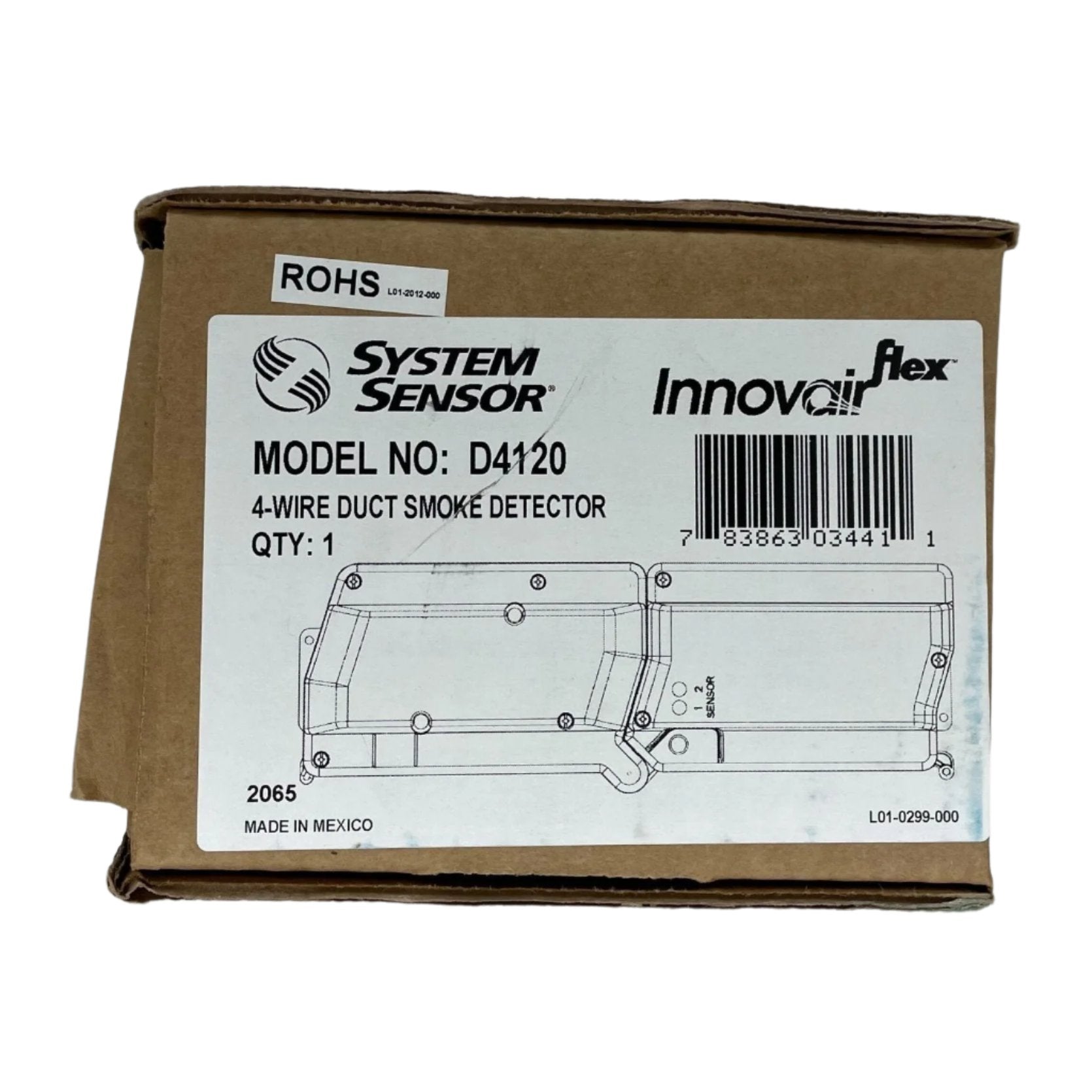
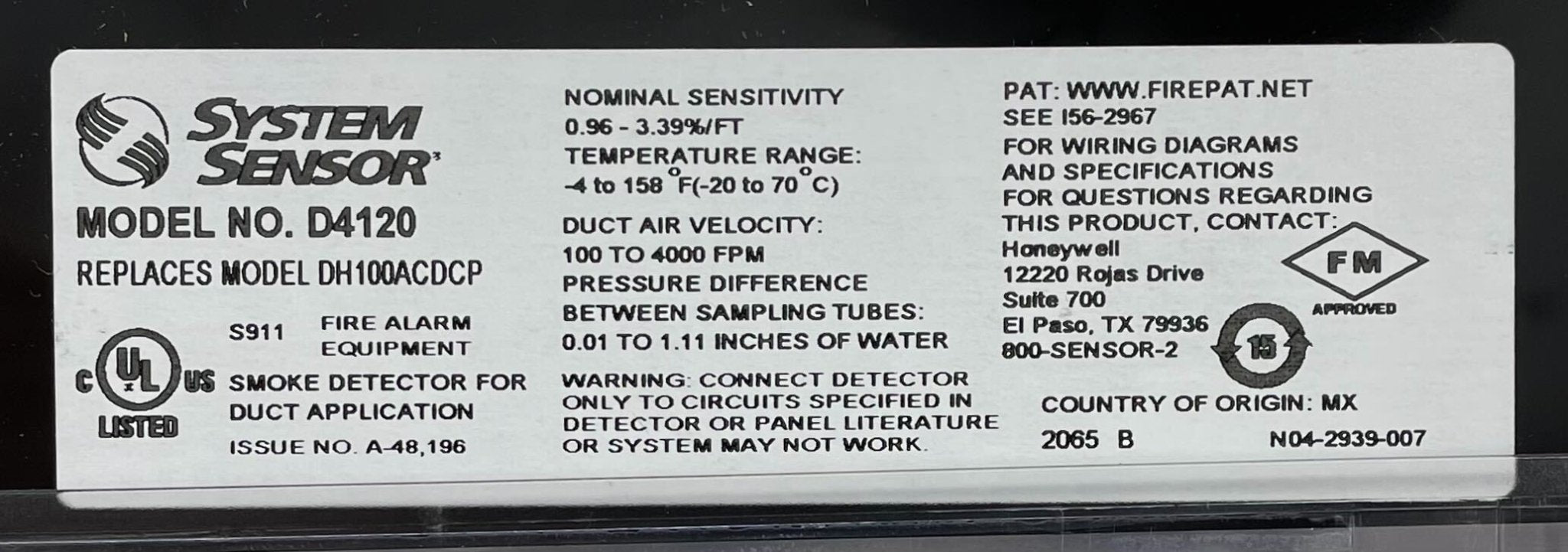
D4120 — System Sensor InnovairFlex 4-wire photoelectric low-flow duct smoke detector, a complete detector comprising the D4P120 power board and the D4S plug-in sensor.
The InnovairFlex D4120 uses a pivoting housing that fits both square and rectangular footprints and mounts to round or rectangular ductwork, so a single part number covers most duct geometries. It senses smoke in demanding conditions — airflow from 100 to 4,000 feet per minute, −4°F to 158°F, and 0 to 95% relative humidity non-condensing. The plug-in sensor head gives improved false alarm immunity and simplifies installation, testing and maintenance, and an improved cover design isolates the sensor head from the low-flow feature. The housing provides ample wiring space, a ¾-inch conduit knockout, high contrast terminal designations and built-in short circuit protection to prevent damage from wiring errors. An easy-access Test/Reset button allows the unit to be tested with the cover on, and three DIP switches configure cover tamper delay, the number of sensors controlled, and the shut-down-on-trouble option. Two LEDs on each power board indicate Standby, Maintenance, Trouble and Alarm, with a quick reference imprinted on the cover.
Specifications
| Type |
4-wire photoelectric low-flow duct smoke detector |
| Power supply voltage |
20–29 VDC, 24 VAC 50–60 Hz, or 120 VAC 50–60 Hz |
| Max standby current |
21 mA @ 24 VDC; 65 mA RMS @ 24 VAC 60 Hz; 20 mA RMS @ 120 VAC 60 Hz |
| Max alarm current |
65 mA @ 24 VDC; 135 mA RMS @ 24 VAC 60 Hz; 35 mA RMS @ 120 VAC 60 Hz |
| Alarm initiation contacts (SPST) |
2.0 A @ 30 VDC (resistive) |
| Alarm auxiliary contacts (DPDT) |
10 A @ 30 VDC (resistive); 10 A @ 250 VAC (resistive); ½ HP @ 240 VAC; ¼ HP @ 120 VAC |
| Supervisory contacts (SPDT) |
2.0 A @ 30 VDC (resistive); 2.0 A @ 125 VAC (resistive) |
| Alarm response time |
15 seconds |
| Power up time |
35 seconds max |
| Reset time |
0.03 to 0.3 sec with RTS151; 0.6 sec max by power down |
| Reset voltage |
3.0 VDC min; 2.0 VAC min (24 VAC); 10 VAC min (120 VAC) |
| Input capacitance |
270 µF max (24 VDC and 24 VAC); not applicable on 120 VAC |
| Air duct velocity |
100 to 4,000 ft/min (0.5 to 20.32 m/sec) |
| Operating temperature range |
D4120 and D4S: −4°F to 158°F (−20°C to 70°C); D4P120: −40°F to 158°F (−40°C to 70°C) |
| Storage temperature range |
D4120 and D4S: −22°F to 158°F (−30°C to 70°C); D4P120: −40°F to 158°F |
| Operating humidity range |
0% to 95% relative humidity, non-condensing |
| Size, rectangular configuration |
14.38 in (37 cm) length x 5 in (12.74 cm) width x 2.5 in (6.36 cm) depth |
| Size, square configuration |
7.75 in (19.7 cm) length x 9 in (22.9 cm) width x 2.5 in (6.35 cm) depth |
| Weight |
2.5 lbs (1.14 kg) |
| Terminal connections |
Strip and clamp method, 12–18 AWG |
| Listing |
UL 268A, listed specifically for use in air handling systems |
Installation notes
-
Never wire the auxiliary contacts to a panel initiating circuit. The DPDT alarm auxiliary contacts are for fan shutdown and similar duties. Use the SPST alarm initiation contact for the control panel — this is stated explicitly in the data sheet and is a common and serious wiring error.
-
Interconnect for multi-fan shutdown: up to 50 D4120 units, 50 D4P120 units, or 50 of a combination may be interconnected. When one unit senses smoke, all interconnected detectors switch their relays, but only the detector that sensed smoke goes into alarm, which pinpoints the fire source.
-
Interconnect rules: all interconnected units must be powered from the same independent supply, and polarity must be maintained throughout — INT+ to INT+, INT/AUX− to INT/AUX−. An alarm can be reset only at the initiating device, not at the interconnected devices.
-
2:1 sensor-to-power: the D4120 power board can monitor a second D4S sensor simultaneously, for example supply and return side on one board. This feature is only available on the D4120 4-wire conventional models, and is arranged either as one D4120 plus one D4S, or two D4S plus one D4P120.
-
Accessory load limits: any combination of accessories may be used provided the loads total 110 mA or less at the Aux output and 50 mA or less at the Alarm output.
-
Testing: locally by magnetic switch or the Test/Reset button on the cover, or remotely with the RTS151KEY remote test station or the RTS2-AOS multi-signalling accessory.
-
Sampling tube must match duct width: DST1 up to 1 ft, DST1.5 for 1–2 ft, DST3 for 2–4 ft, DST5 for 4–8 ft, DST10 for 8–12 ft. The patented tube installs from the front or back with no tools.
-
Not a substitute for open area detection: duct smoke detectors are not a substitute for open area smoke detectors, not a substitute for early warning detection, and not a replacement for a building’s regular fire detection system. Refer to NFPA 72 and NFPA 90A.
Related models
-
D4120W — the watertight version of this detector for wet or outdoor locations.
-
D4S — 4-wire photoelectric sensor component only, used as the second sensor in a 2:1 arrangement.
-
D4P120 — 4-wire photoelectric power board component only, 24 VAC/DC and 120 VAC.
-
DNR / DNRW — the intelligent (addressable) non-relay InnovairFlex duct detectors, for SLC systems rather than 4-wire conventional.
-
RTS151KEY — keyed remote test station; RTS2-AOS multi-signalling accessory with add-on strobe; RA100Z remote annunciator; APA151 remote annunciator with piezo alarm.
-
M02-04-00 — test magnet; ETX metal exhaust tube; P48-21-00 end cap for metal sampling tubes.
Specifications taken from the System Sensor data sheet “D4120 Duct Smoke Detector,” document HVDS00502 (10/13). Manufacturer specifications are subject to change without notice.