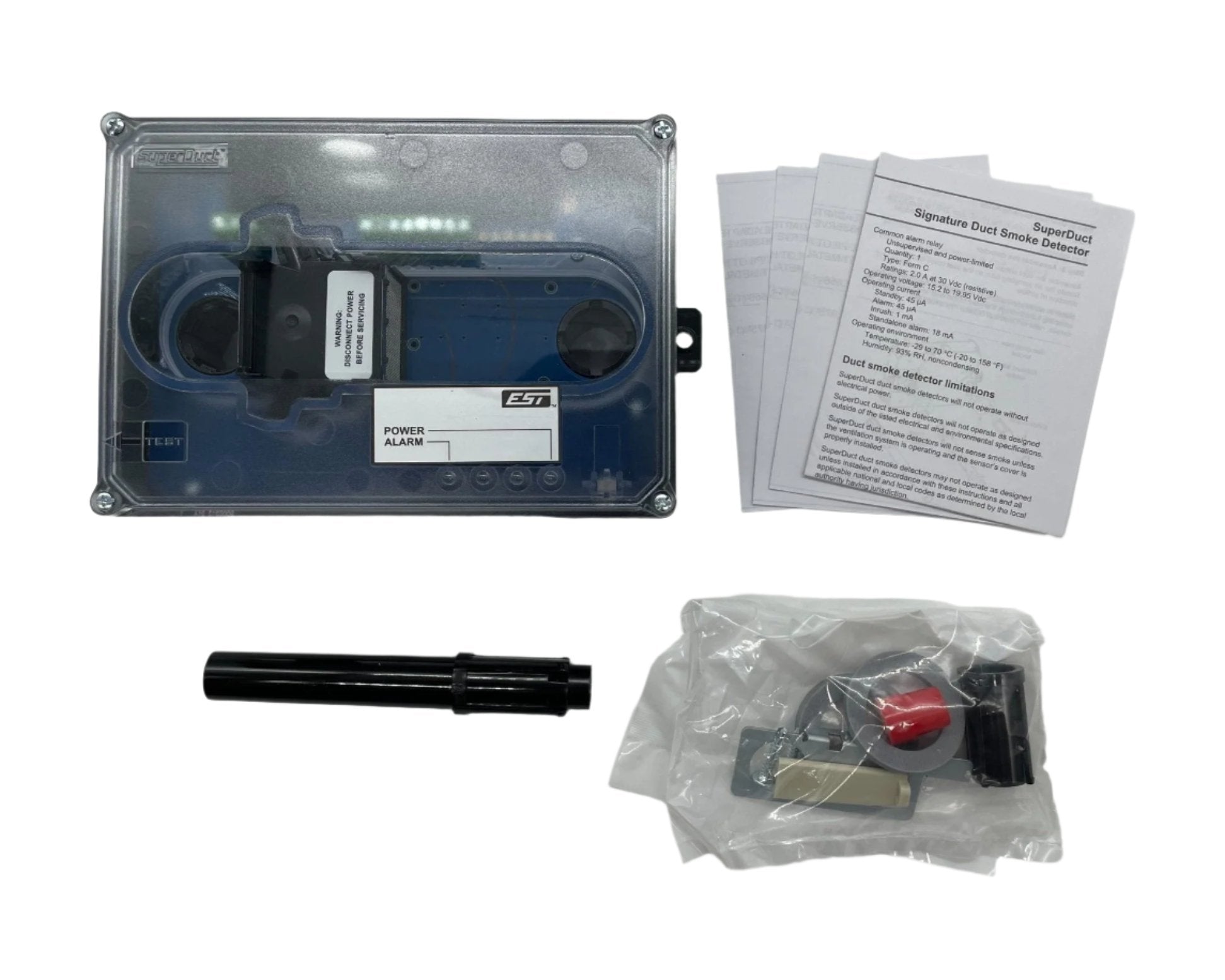
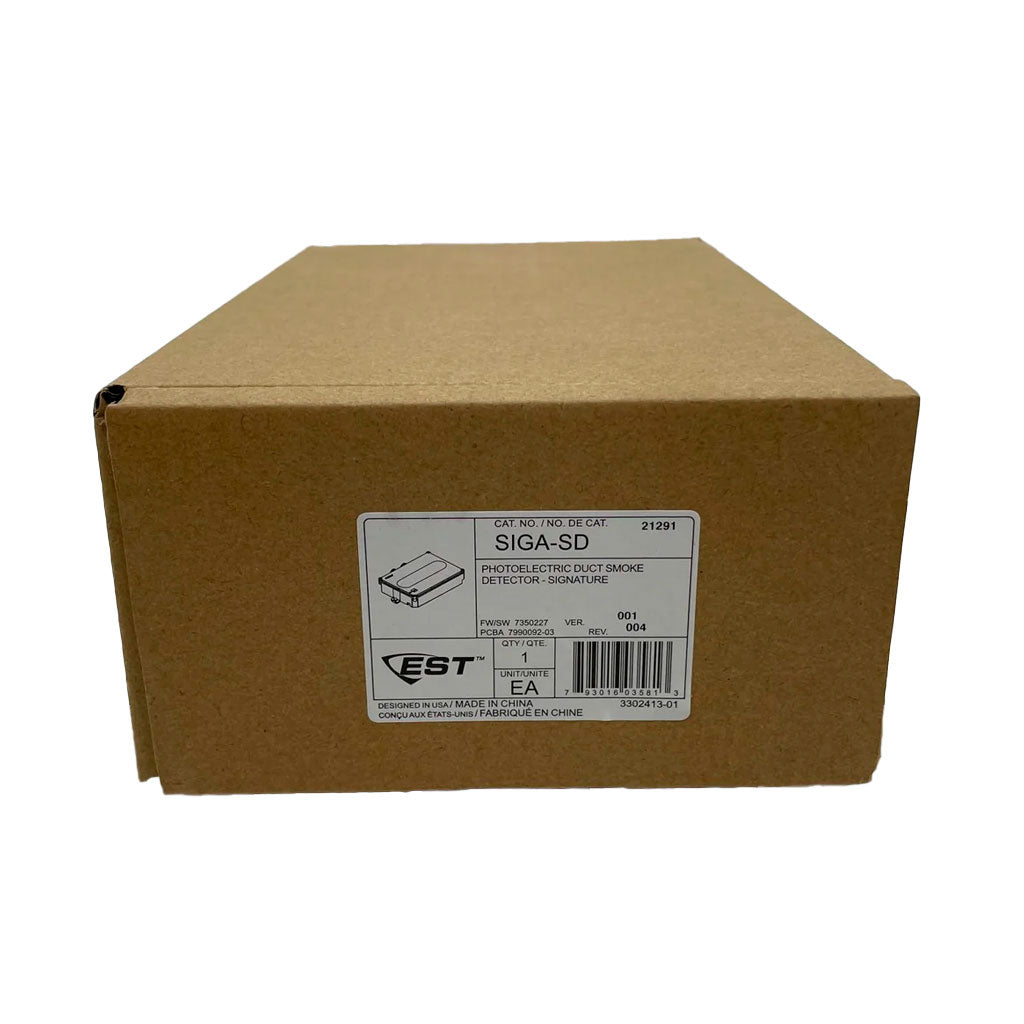
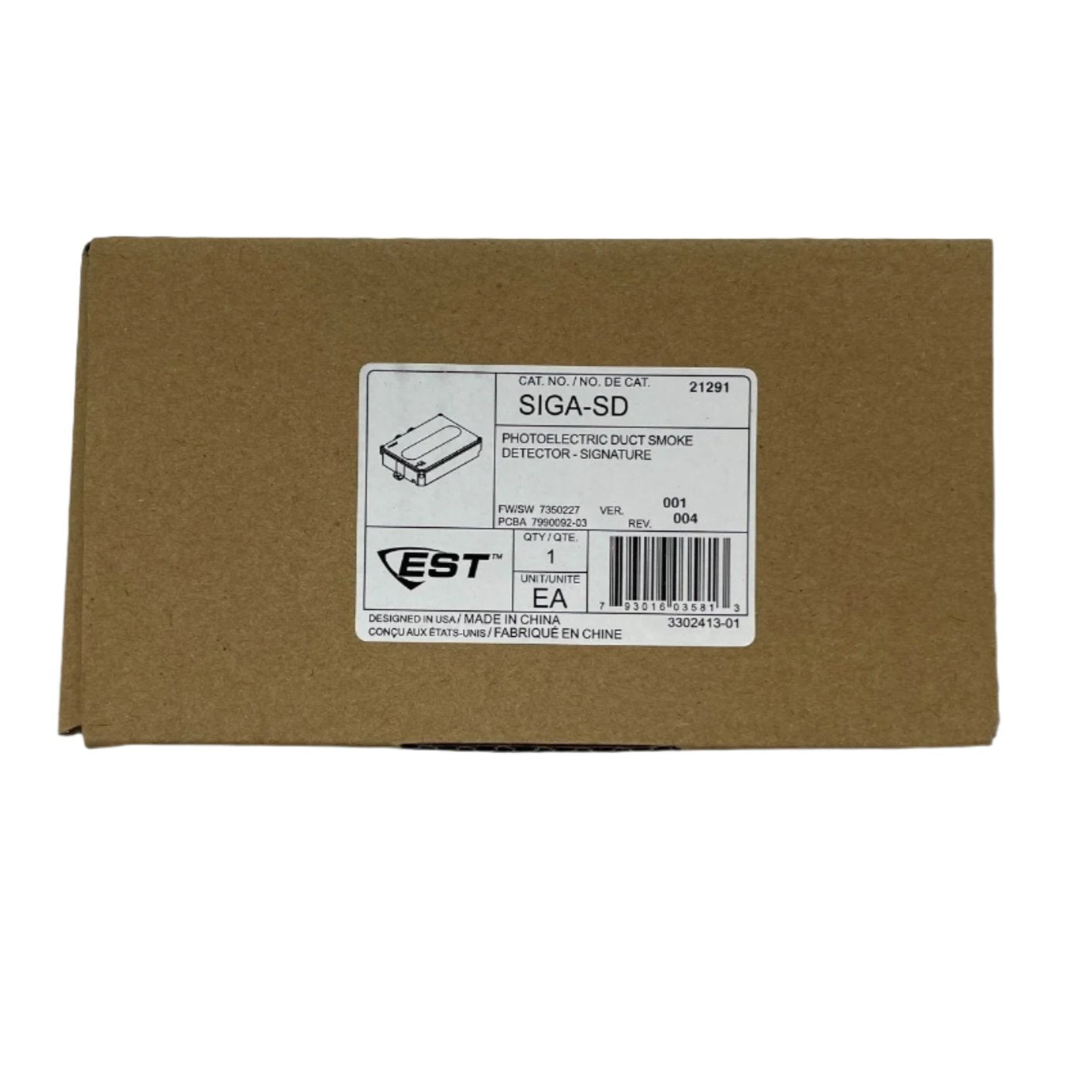
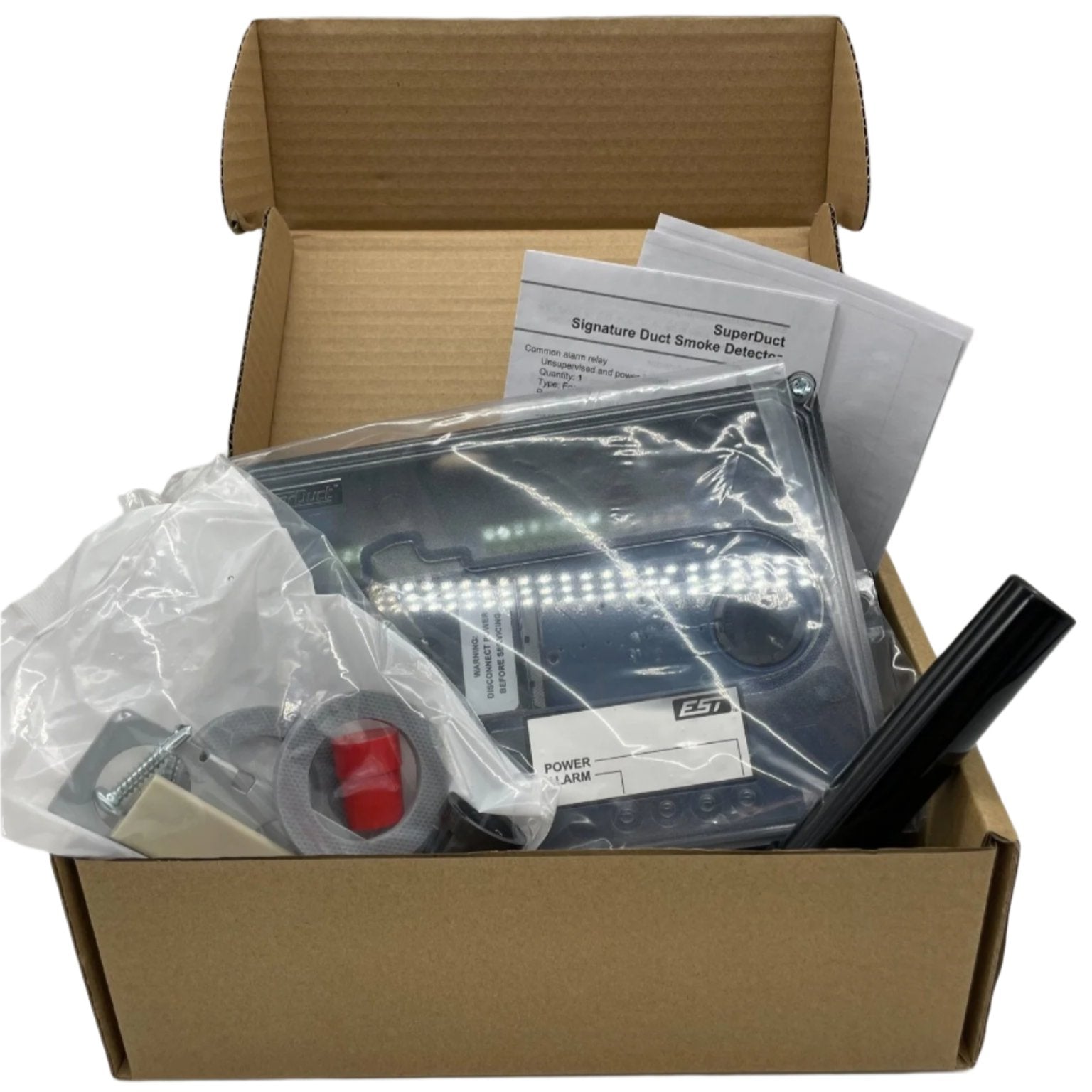
Edwards SIGA-SD — an intelligent SuperDuct Signature Series duct smoke detector that samples HVAC airflow and reports as an addressable device on a Signature loop.
A Signature Series photoelectric sensor is built into every SIGA-SD, gathering analog information from the smoke sensing elements and converting it into digital signals; the sensor compares those signals against historical readings and time patterns to make an alarm decision, with digital filters removing signal patterns that are not typical of fires. Differential sensing keeps gradual environmental change from triggering unwanted alarms — a rapid change such as smoke from a fire causes an alarm, while dust and debris accumulating over time does not shift alarm sensitivity. Air enters the sensing chamber through a sampling tube that extends into the duct and returns through an exhaust tube, the pressure difference between the two pulling sampled air through the chamber.
The assembly is less than 2 in. deep for tight installations, uses removable dust filters and conformally coated circuit boards, and comes apart and snaps back together for cleaning. The exhaust tube is included; the sampling tube is a separate order sized to the duct.
Specifications
| Detection method |
Photoelectric (light scattering principle) |
| Sensitivity |
0.79 to 2.46 %/ft obscuration |
| Air velocity rating |
100 to 4,000 ft/min, meeting the required minimum air pressure differential |
| Air pressure differential |
0.005 to 1.00 inches of water |
| Operating voltage |
15.2 to 19.95 VDC |
| Operating current |
Standby 45 µA; alarm 45 µA; inrush 1 mA; standalone alarm 18 mA |
| Common alarm relay |
One Form C, unsupervised and power-limited, rated 2.0 A at 30 VDC (resistive) |
| Alarm test response time |
5 seconds |
| LED indicators |
Alarm (red), power (green) |
| Operating temperature (UL) |
-20 to 158°F (-29 to 70°C) |
| Operating temperature (ULC) |
-4 to 120°F (see installation note on the stated Celsius value) |
| Relative humidity |
10 to 93%, noncondensing |
| Dimensions |
8.70 x 5.45 x 1.90 in. (221 x 138 x 48 mm) |
| Wire size |
14 to 22 AWG |
| Agency listings |
UL, ULC, CSFM (3242-1657:0223), FM, MEA |
| Ship weight |
2.4 lb (1.1 kg) |
Installation notes
-
Sampling tube is ordered separately: the exhaust tube is supplied with the detector, but the sampling tube is not. Size it to the duct from the SD-T8, SD-T18, SD-T24, SD-T36, SD-T42, SD-T60, SD-T78 or SD-T120 range.
-
Tube orientation: sampling tubes must be installed with the inlet holes facing the airstream, and may be rotated in 45-degree increments so the unit can be mounted at virtually any angle relative to airflow. The sampling tube may be installed from either the duct side or from inside the sensor compartment; the exhaust tube must be installed from the duct side.
-
A conflicting temperature row: the specification table gives the ULC operating temperature as “-4 to 120 °F (-29 to 49 °C).” Those two ranges do not agree — -4°F is -20°C, not -29°C, and -29°C is the low end of the separate UL range in the row above. Treat the ULC low-temperature limit as unresolved on this data sheet and confirm it with Edwards for a cold-duct application. The UL range, -20 to 158°F (-29 to 70°C), is self-consistent.
-
Verify the duct before installing: Edwards directs that duct air velocity, temperature and humidity be tested before installation to confirm they fall within the detector’s operating range. The SD-VTK air velocity test kit exists for this.
-
One remote device only: no more than one remote test station or LED indicator may be connected to the detector at the same time. That wiring is unsupervised, and maximum wire resistance is 10 ohms per wire.
-
High humidity: use the SD-PH protective housing in high-humidity environments to prevent condensation. The SD-PH is weatherized against outdoor air but is not intended for direct outdoor exposure.
-
Duct detectors have limits: Edwards warns that a duct detector is not a substitute for an open-area smoke detector, not a substitute for early warning detection, and not a replacement for a building’s regular fire detection system. It will not operate without electrical power.
-
Migration: standard sampling tube spacing allows drop-in replacement of other duct detectors, and the cover monitor switch and magnet-activated test switch are built in.
Related models
-
SD-TRM / SD-TRK — remote test/reset stations providing alarm test, trouble indication and reset from a remote location; SD-TRM is magnetically operated (200 VDC, 0.5 A max switch rating), SD-TRK is key operated (125 VDC, 4 A max).
-
SIGA-LED — remote alarm LED, an alternative to a test station where only indication is needed (3 VDC, 30 mA max).
-
SIGA-SDPCB — replacement PCB and Signature sensor kit for an installed SuperDuct housing.
-
SD-PH — protective housing for high-humidity environments; SD-GSK cover gasket kit and SD-MAG test magnet kit are also available.
Specifications taken from the Edwards data sheet “Intelligent Duct Smoke Detector — SIGA-SD,” document E85001-0584, Issue 1.1. Manufacturer specifications are subject to change without notice.