
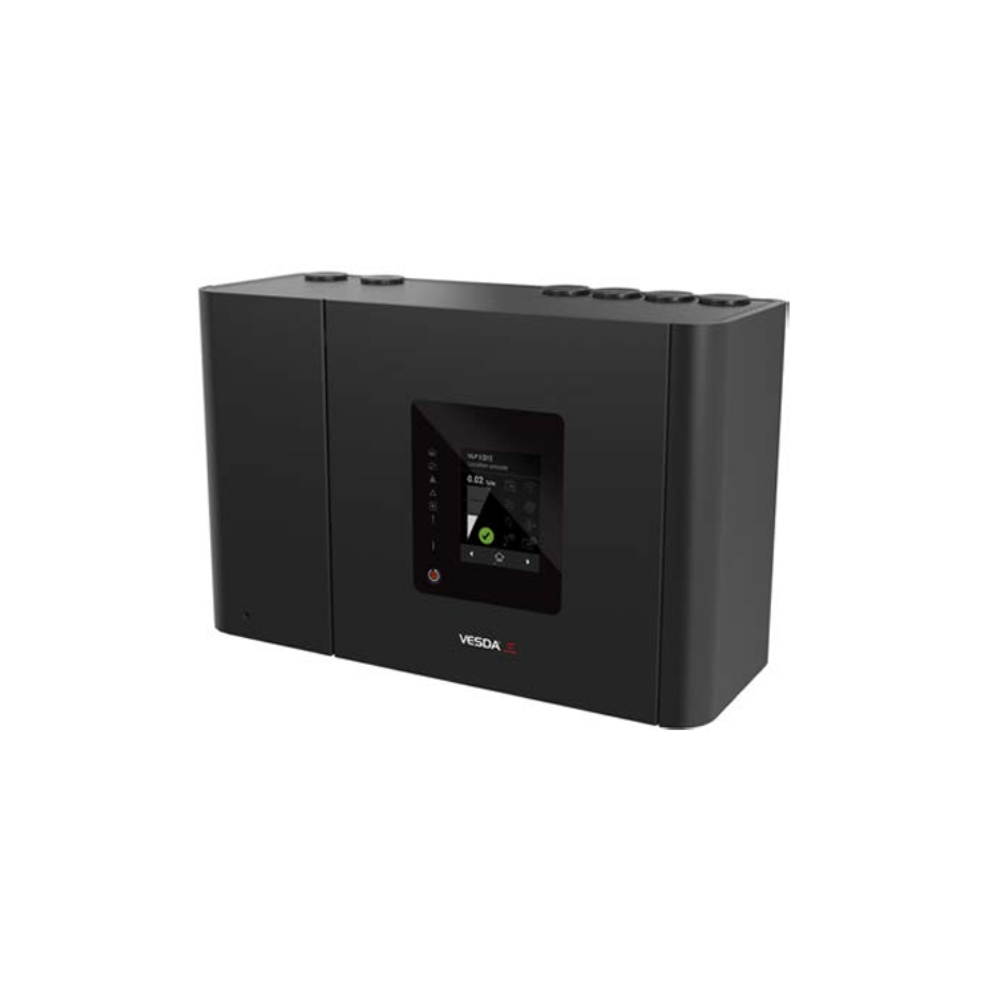
Choose the VESDA-E VEP for mainstream very early warning with one or four pipes, the VEU where you need the highest sensitivity and the longest pipe network, and the VES when you must know which of four pipes the smoke came from. For US work, order the codes ending in -UL.
What is a VESDA aspirating smoke detector, and when is it used?
VESDA is the aspirating smoke detection (ASD) brand of Xtralis, whose documents are now published by Xtralis and Honeywell. It is a brand, not a generic term. A VESDA detector does not wait for smoke to reach it: an aspirator draws air continuously through a network of sampling pipes, through a filter and into a laser detection chamber.
The detectors report four alarm levels, named Alert, Action, Fire 1 and Fire 2, so a site can investigate at a low smoke level before a fire alarm is raised. Xtralis positions them for places where early warning matters or where spot detectors struggle: data and telecom rooms, clean rooms, cold storage, warehouses, heritage buildings and correctional facilities.
VEP vs VEU vs VES: what is the difference?
All three share the Flair detection chamber, VESDAnet, and the same 13.8 x 8.9 x 5.3 inch footprint. They differ in sensitivity, pipe capacity and whether the pipes are identified separately. The figures below come from the Xtralis UL 268 7th Edition data sheets; the pipe network for any project must be designed and verified in the Xtralis ASPIRE software.
| VEP, one pipe | VEP, four pipe | VEU | VES | |
|---|---|---|---|---|
| Xtralis position | Mainstream ASD | Mainstream ASD | Highest sensitivity ASD | Sector addressable ASD |
| UL codes | VEP-A00-1P-UL | VEP-A00-P-UL, VEP-A10-P-UL | VEU-A00-UL, VEU-A10-UL | VES-A00-P-UL, VES-A10-P-UL |
| Area coverage, up to | 10,760 sq ft | 21,520 sq ft | 69,965 sq ft | 21,520 sq ft |
| Pipe inlets | 1 | 4 | 4 | 4, each reported as a sector |
| Total pipe with branches | 427 ft | 1,542 ft | 2,001 ft | 1,706 ft |
| Longest run with all pipes in use | 312 ft | 230 ft per pipe | 312 ft per pipe | 230 ft per pipe |
| Maximum sampling holes | 33 | 80 | 96 | 98 |
| Sensitivity range, % obscuration per ft | 0.0015 to 6.575 | 0.0015 to 6.575 | 0.0003 to 6.575 | 0.0015 to 6.575 |
| Programmable relays | 7 | 7 | 7 | 12 |
| Enclosure | Plastic | Plastic | Aluminum | Plastic |
Xtralis notes that system design and regulations may restrict the VEU's monitored area to less than the maximum, and marks the VES pipe and hole figures as subject to agency confirmation.
- VEP: the general-purpose choice. The one-pipe model suits a single small room or cabinet row; the four-pipe model covers larger rooms.
- VEU: the most sensitive of the range, with the most pipe. Xtralis describes it for high-airflow spaces and high ceilings.
- VES: treats each of its four pipes as a sector with its own four alarm thresholds. When smoke reaches the scan threshold it scans the pipes and reports the first sector to reach Alert, which narrows the search area.
- VEA: a different approach for pinpoint location, with 40 addressable microbore tubes instead of pipes.
How do I read a VESDA-E part number (A00 vs A10, -P vs -1P, -UL)?
Read it in four parts, using the descriptions in Xtralis' ordering tables.
| Part of the code | Meaning in the Xtralis ordering tables |
|---|---|
| VEP, VEU, VES, VEA | The detector family. |
| A00 | Front with LEDs. |
| A10 | Front with a 3.5 inch display. |
| -1P | One-pipe VEP. |
| -P | On VEP, the four-pipe model. Every VEP and VES code with a P is described as a plastic enclosure; VEU codes have no P and are aluminum. Xtralis does not publish a letter-by-letter key that we could find, so treat "P" as our reading of those descriptions. |
| -UL | The UL 268 7th Edition version, sold in the Americas. |
The -UL suffix is the one that matters when ordering. In a May 2024 notice for the Americas, Xtralis discontinued the UL 268 6th Edition SKUs and named a 7th Edition alternative for each: VEP-A00-P became VEP-A00-P-UL, VEU-A10 became VEU-A10-UL, VES-A10-P became VES-A10-P-UL, and so on. Last shipments of the 6th Edition codes were set for June 30, 2024.
The same notice says the 7th Edition detectors are electrically compatible on VESDAnet, but pipe designs must be reviewed in ASPIRE against the 7th Edition transport times. A -UL detector is therefore not automatically a drop-in on an older pipe network: the published limits differ. The earlier four-pipe VEP data sheet allowed 1,837 ft of branched pipe, the 7th Edition sheet 1,542 ft. Whether a 6th Edition code is acceptable as a service spare on an existing system is a question for the AHJ.
Which VESDA-E model replaces the legacy VLP, VLS, VLC and VLF?
Xtralis has published the migration path:
| Legacy detector | Status per Xtralis | VESDA-E alternative per Xtralis |
|---|---|---|
| VLP (LaserPLUS) | Discontinued; end-of-life notice May 2019 | VEP or VEU, described as a direct replacement, with the same mounting footprint and pipe, conduit and connector positions |
| VLC (LaserCOMPACT) | Discontinued with the VLP | One-pipe VEP |
| VLS (LaserSCANNER) | Discontinued with the arrival of the VES | VES, described as backward compatible with the VLS |
| VLF (LaserFOCUS) | Not discontinued. VLF-500 has a UL 268 7th Edition version, VLF-500-00-UL. The 2024 notice lists no replacement for VLF-250-00. | Not applicable |
| VLI (industrial) | Not carried forward to UL 268 7th Edition; Xtralis gave June 2024 as end of life for VLI-880 and VLI-885 | None named |
The 2019 notice named the then-current codes (VEP-A00-P, VEP-A10-P, VEP-A00-1P). For a US order today, use the -UL versions of those codes and have the pipe network checked in ASPIRE.
What drives the cost of a VESDA system?
We do not quote prices in a guide because they change. The parts that set the budget are:
- The detector. Family (VEP, VES, VEU) and front (A00 LEDs or A10 display).
- The pipe network. Pipe, fittings, capillaries and sampling points, sized by the area and the ASPIRE design.
- Power. A listed 24 VDC supply with batteries. The detectors run on 18 to 30 VDC; the four-pipe VEP draws about 0.29 to 0.38 A quiescent depending on aspirator setting, and the VEU up to 0.61 A at its highest setting. See power supplies.
- Maintenance. The VSP-962 filter, which Xtralis recommends replacing every two years or on a filter fault, and periodic pipe maintenance.
- Design and commissioning. ASPIRE design, AutoLearn and the commissioning smoke test.
What to order
Common UL models are the VEP-A10-P-UL, the VEP-A00-1P-UL, the VEU-A10-UL and the VES-A10-P-UL. We also list the earlier codes without -UL, such as the VEP-A00-P and VEP-A00-1P; check with the AHJ before using one on new work. Everything else is in the aspirating smoke detectors and VESDA collections.
A VESDA project is a designed system, so request a quote with the area, ceiling height and the panel it reports to.
Compatibility must be confirmed against the control panel's listing documents, and the design and installation must follow NFPA 72 and the local AHJ.
Sources
- Xtralis, VESDA-E VEP (UL 268 7th Ed.) data sheet, Doc. No. 36106_07, July 2025: xtralis.com/file/12015
- Xtralis, VESDA-E VEU (UL 268 7th Ed.) data sheet, Doc. No. 36107_05, November 2024: xtralis.com/file/12017
- Xtralis, VESDA-E VES (UL 268 7th Ed.) data sheet, Doc. No. 36105_05, November 2024: xtralis.com/file/12016
- Xtralis Product Bulletin, VESDA-E UL268 6th Edition End of Life Notice (Americas only), Doc 37870_01, May 2024: xtralis.com/file/12064
- Xtralis Product Bulletin, VESDA VLP/VLC End of Life Notice, Americas, Doc 35269_02, May 2019: xtralis.com/file/9910
- Xtralis, UL268 7th Edition Frequently Asked Questions, Doc. 37083_05: xtralis.com/file/12026
- Xtralis product pages for the VEP, VEU, VES, VLS and VLF: VEP, VEU, VES, VLS, VLF
- Xtralis, VESDA-E VEP data sheet (international edition), Doc. No. 22063_07: prod-edam.honeywell.com
- Xtralis, VESDA-E VEA data sheet, Doc. No. 22210_09: prod-edam.honeywell.com
- Xtralis, VESDA-E VEU-A00 Product Guide, Doc. No. 22061_15, August 2021: prod-edam.honeywell.com
- Xtralis, VESDA Product Line Brochure (file 11273-14): prod-edam.honeywell.com