
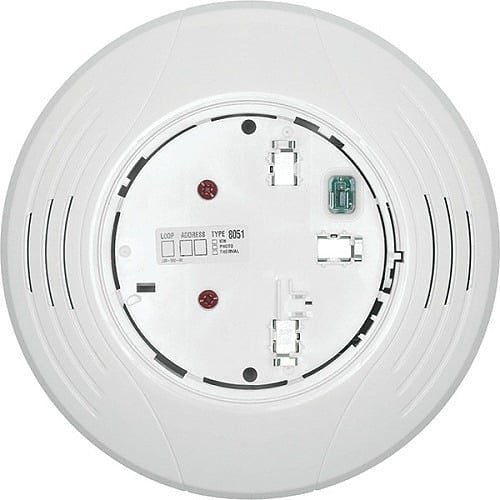
The B200S is an addressable sounder base that the panel commands by address. The B200SR is a retrofit sounder base that sounds with its own detector and replaces B501BH-series installations. The -LF versions of both produce the 520 Hz low-frequency tone that NFPA 72 calls for in sleeping areas.
The comparison below comes from the Notifier intelligent bases data sheet (DN-60054) and the System Sensor installation manuals.
B200S vs B200SR: what is the difference?
| Feature | B200S / B200S-LF | B200SR / B200SR-LF |
|---|---|---|
| How it is controlled | Takes the same address as the detector but as its own device type; the panel can command one sounder or a group | Sounds when the panel activates the detector plugged into it; all bases sound when the external 24 V supply polarity is reversed |
| Intended use | Addressable, programmable sounder base; the data sheet lists the B200S as using FlashScan protocol | Retrofit; fully compatible with existing B501BH Series sounder base installations |
| Tones | Temporal 3, Temporal 4, continuous, March Time; custom patterns on some panels | Temporal 3 or continuous, selected by a jumper |
| Volume | Selectable: greater than 75 dBA or greater than 85 dBA | Greater than 85 dBA |
| Synchronization | Recognizes the System Sensor sync protocol, so it can join the general evacuation signal | Local grouping of up to six B200SR bases through the interconnect terminal; that grouping is unsupervised and for supplementary use only |
| Alarm current, standard version | 35 mA at high volume, 15 mA at low volume | 35 mA |
| Alarm current, -LF version at 24 VDC | 90 mA at high volume, 20 mA at low volume | 90 mA |
| Diameter | 6.875 in. | 6.875 in. |
The -LF current rises as voltage falls: the B200S-LF draws up to 140 mA at 16 VDC on high volume and the B200SR-LF up to 125 mA, so size the 24 V circuit for the low-voltage figure.
Which panels support each? Notifier's low-frequency bulletin names the NFS-320, NFS2-640 and NFS2-3030 as compatible with the B200S-LF. For any other panel, and for the standard B200S, check the panel's SLC manual and compatibility document, because the B200S sits on the loop as its own device type.
Suffixes: -WH is white, -IV is ivory, and an A after the model (B200SA, B200SRA) marks the ULC-listed version.
What does -LF mean, and when is a 520 Hz low-frequency sounder required?
-LF means low frequency. The -LF bases produce a fundamental frequency of 520 Hz, plus or minus 10 percent, with a square wave or its equivalent, instead of the high-frequency tone (about 3150 Hz, according to NFPA) that fire alarm sounders typically use.
On the code requirement, these are the statements in the documents we read:
- System Sensor's B200SR-LF manual says NFPA 72 requires, effective January 1, 2014, that audible appliances installed in sleeping areas produce a low-frequency alarm signal that is a square wave, or gives equivalent awakening ability, with a fundamental frequency of 520 Hz plus or minus 10 percent.
- Notifier's December 2014 bulletin says low-frequency audible appliances are required by the 2010 and 2013 editions of NFPA 72 for sleeping spaces, and gives hotels, motels, apartment buildings, condominiums, dormitories, assisted living and health care facilities as typical applications.
- An NFPA article from January 2021 explains the scope: the 2013 edition requires audible appliances that are initiated by the building fire alarm system and provided in sleeping areas to wake occupants to be low-frequency 520 Hz appliances.
- The Minnesota State Fire Marshal locates the requirement at Section 18.4.5.3 of the 2016 edition and notes that NFPA 72 does not define "sleeping area", which is why interpretations differ.
In practice the answer depends on which edition of NFPA 72 your jurisdiction has adopted and on how the AHJ reads "sleeping area". Confirm both before choosing between a standard and an -LF base.
Which detector heads fit these bases?
The data sheet describes the sounder bases as specialty bases for the 900 Series of addressable detectors as well as previous generations. The manuals say the bases are used with addressable detector heads and send the installer to System Sensor's base and sensor cross-reference chart for the list of compatible heads. The B200S manual also carries a note that sounder bases are not compatible with remote-test-capable detectors in the Select Series.
We have not reproduced a head-by-head list because the manufacturer keeps it in that chart. To match a base to a detector already installed, check the chart or include the detector model when you request a quote.
Do sounder bases need separate 24 V power?
Yes. The SLC carries the detector and the base's addressing; the sounder runs on an external supply rated 16 to 33 VDC. The two connections are isolated from each other.
- B200SR and B200SR-LF: require an external 24 VDC power supply.
- B200S: connects to either 24 VDC constant power or a NAC, depending on the panel and the intended use. On a NAC, an end-of-line resistor is required for Class B operation.
The manuals add that when the bases are not used as a supplementary evacuation system, the external 24 VDC supply is treated as part of the main power supply under NFPA 72.
HWL-LF vs P2WL-LF: low-frequency sounder or sounder strobe?
Where a sounder base is not the right fit, System Sensor makes 520 Hz wall and ceiling appliances for the NAC:
| Model | What it is | Replaced (per Honeywell's cross-reference guide) |
|---|---|---|
| HWL-LF / HRL-LF | L-Series low-frequency sounder, wall, white / red | HW-LF / HR-LF |
| P2WL-LF / P2RL-LF | L-Series low-frequency sounder strobe, wall, white / red | P2WH-LF / P2RH-LF |
System Sensor's current low-frequency data sheet (AVDS-62202, October 2025) no longer lists those part numbers. It lists the sounders as HWL2-LF and HRL2-LF for walls, HGWL2-LF and HGRL2-LF in the compact size and HCWL2-LF and HCRL2-LF for ceilings. It lists the sounder strobes as LED models: P2WLED-LF and P2RLED-LF for walls, PC2WLED-LF and PC2RLED-LF for ceilings.
The data sheet does not publish a part-for-part replacement table, so we are not stating that HWL2-LF replaces HWL-LF or that P2WLED-LF replaces P2WL-LF. It does say the current models are electrically compatible with legacy SpectrAlert Advance and L-Series devices at 16 to 33 VDC and synchronize through a power supply that supports the System Sensor protocol or an MDL3 module. They run on regulated 24 VDC only.
Which one should I order?
- Replacing a B501BH-series sounder base, or extending an installation built around them: B200SR-WH or B200SR-IV; where 520 Hz is required, B200SR-LF-WH.
- New work on a panel that supports them: B200S-WH; where 520 Hz is required, B200S-LF-WH.
See all sounder bases and sounders. Compatibility must be confirmed against the control panel's listing documents, and the installation must follow NFPA 72 and the local AHJ.
Sources
- NOTIFIER, Intelligent Bases: Standard, Relay, Isolator, Sounder and Low-Frequency Sounder Bases data sheet, DN-60054:K, 7/18/2018
- System Sensor, B200S-WH / B200S-IV Intelligent Sounder Base installation manual, I56-3387-009
- System Sensor, B200SR-WH / B200SR-IV Intelligent Sounder Base installation manual, I56-3392-011
- System Sensor, B200SR-LF Low Frequency Intelligent Sounder Base installation manual, I56-4152
- NOTIFIER product bulletin, Low Frequency (520 Hz) Audible Solutions, December 30, 2014
- NFPA, "Low Frequency Fire and Smoke Alarms", January 22, 2021
- Minnesota State Fire Marshal, "Low frequency fire alarm signals" interpretation (archived copy)
- Honeywell, Audible Visible (AV) Notification Cross-Reference Guide, AVFL88909, 11/08/2023
- System Sensor, L-Series Low Frequency Sounders and L-Series with LED Low Frequency Sounder Strobes data sheet, AVDS-62202, 10/2025