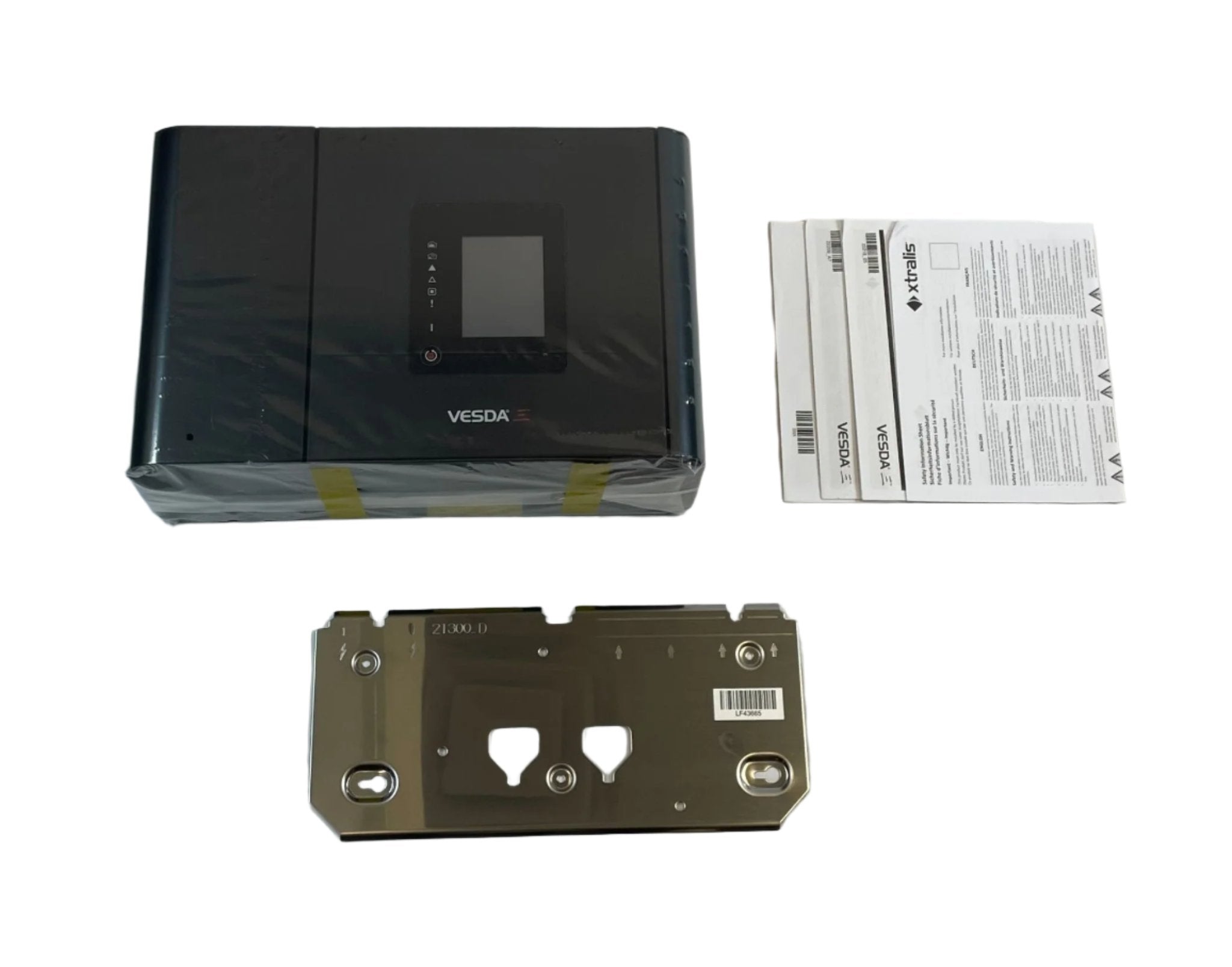
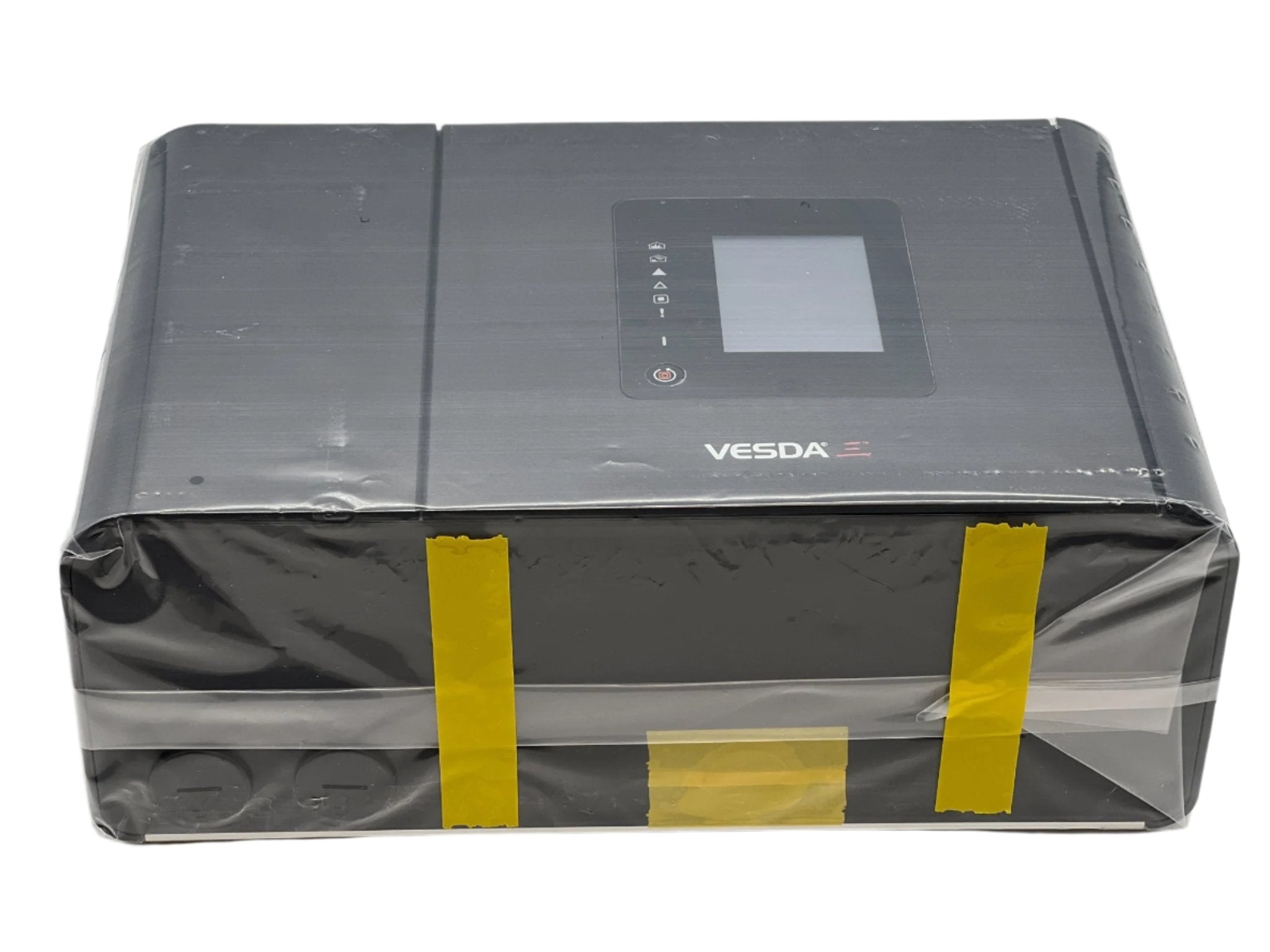
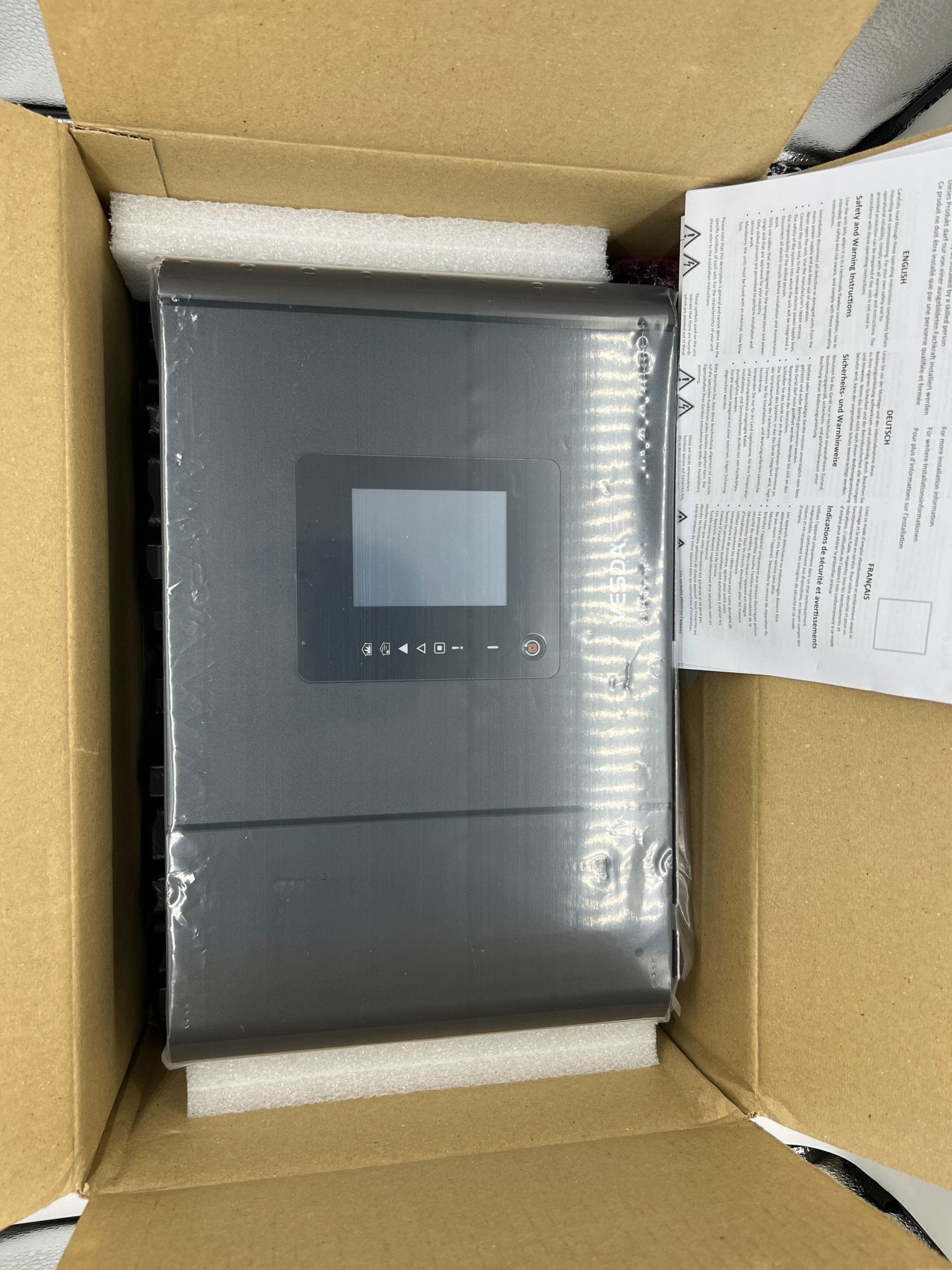
VEP-A10-P — VESDA-E VEP aspirating smoke detector, four sampling pipes, 3.5 in display, plastic enclosure.
The VEP is the mainstream VESDA-E detector, built on Flair detection technology: a CMOS imager working with multiple photo-diodes images the sampled particles directly, which yields both very early warning and the particle data used to reject nuisance sources. Absolute calibration holds that performance steady over the detector's life. The A10-P is the fully configured member of the line — four inlet pipes driving up to 560 m (1,837 ft) of branched sampling network across 2,000 m², with a 3.5 in LCD that reports zone number and name, live smoke level against the alarm thresholds, and discrete fault icons for aspirator, airflow, power, filter, smoke chamber, VESDAnet and StaX module conditions. Ethernet, WiFi, USB and VESDAnet are all standard.
Specifications
| Order code |
VEP-A10-P — VESDA-E VEP with 3.5 in display, 4 pipe |
| Supply voltage |
18 to 30 VDC (24 V nominal) |
| Power consumption at 24 VDC |
Aspirator setting 1: 8.2 W quiescent, 10.4 W in alarm. Aspirator setting 5: 10.0 W quiescent, 11.6 W in alarm |
| Dimensions |
350 mm x 225 mm x 135 mm (13.8 in x 8.9 in x 5.3 in) |
| Weight |
4.1 kg (9.0 lb) |
| Operating conditions |
Ambient 0°C to 39°C (32°F to 102°F); sampled air -20°C to 60°C (-4°F to 140°F); tested to -20°C to 55°C (-4°F to 131°F); UL -20°C to 50°C (-4°F to 122°F); humidity 10% to 95% RH, non-condensing |
| Area coverage |
2,000 m² (21,520 sq ft) |
| Pipe length |
280 m (919 ft) linear; 560 m (1,837 ft) branched |
| Pipe length by pipes in use |
1 pipe 110 m (361 ft); 2 pipes 100 m (328 ft); 3 pipes 80 m (262 ft); 4 pipes 70 m (230 ft) |
| Minimum airflow per pipe |
15 l/m |
| Sampling holes (Class A/B/C) |
40 / 80 / 100 |
| Pipe inlet and exhaust |
External diameter 25 mm or 1.05 in (3/4 in IPS); exhaust via adaptor |
| Relays |
7 programmable relays, latching or non-latching; contacts rated 2 A at 30 VDC (resistive) |
| IP rating |
IP40 |
| Cable access |
4 x 26 mm (1.02 in) cable entries |
| Dynamic range |
0.001% to 32% obs/m (0.0003% to 10% obs/ft) |
| Sensitivity range |
0.005 to 20% obs/m (0.0016% to 6.25% obs/ft) |
| Threshold setting range |
Alert 0.005% to 2.0%; Action 0.005% to 2.0%; Fire 1 0.010% to 2.0%; Fire 2 0.020% to 20.0% obs/m |
| Event log |
Up to 20,000 events, time and date stamped |
| StaX module support |
PSU, Auto Pipe Clean |
| Design tool |
ASPIRE |
| Listings and approvals |
UL, ULC, FM, ActivFire, CE, VdS |
| EN 54-20 / ISO 7240-20 (four pipe VEP) |
Class A: 40 holes, Fire 1 = 0.028% obs/m. Class B: 80 holes, Fire 1 = 0.027% obs/m. Class C: 100 holes, Fire 1 = 0.056% obs/m. Classification of any configuration is determined using ASPIRE |
Installation notes
-
Per-pipe length falls as pipes are added: a single pipe may run 110 m, but on a four-pipe network each pipe is limited to 70 m. The 560 m headline is the branched total across the network, not a per-pipe allowance.
-
Auto Pipe Clean is a four-pipe option: the data sheet lists PSU and Auto Pipe Clean StaX modules for the four-pipe VEP, where the one-pipe VEP-A00-1P is listed for the PSU StaX only.
-
Retrofit footprint: the VEP occupies the same mounting footprint and pipe, conduit and electrical connector positions as the legacy VESDA VLP, and runs on existing VESDAnet installations alongside legacy detectors.
-
Exhaust adaptor: the 3/4 in IPS exhaust connection is made through the VSP-961 adaptor, ordered separately.
-
Display, not sectors: the 3.5 in screen reports one zone. If the requirement is to identify which of four pipes is carrying smoke, that is the VES, not the VEP.
Related models
-
VEP-A00-P — the same four-pipe detector with an LED fascia instead of the 3.5 in display; lower quiescent draw.
-
VEP-A00-1P — one-pipe LED model, 1,000 m² and 130 m branched pipe.
-
VEP-A10-P-UL — the UL-listed four-pipe variant with its own product guide and approvals set.
-
VES-A10-P — same display, four pipes, but adds sector addressability and 12 relays.
-
VSP-962 / VSP-963 / VSP-964 — field-replaceable filter, aspirator and detection chamber spares.
Specifications taken from the Xtralis (Honeywell) data sheet "VESDA-E VEP," document VESDA-E-VEP V.02 (April 2020). Manufacturer specifications are subject to change without notice.