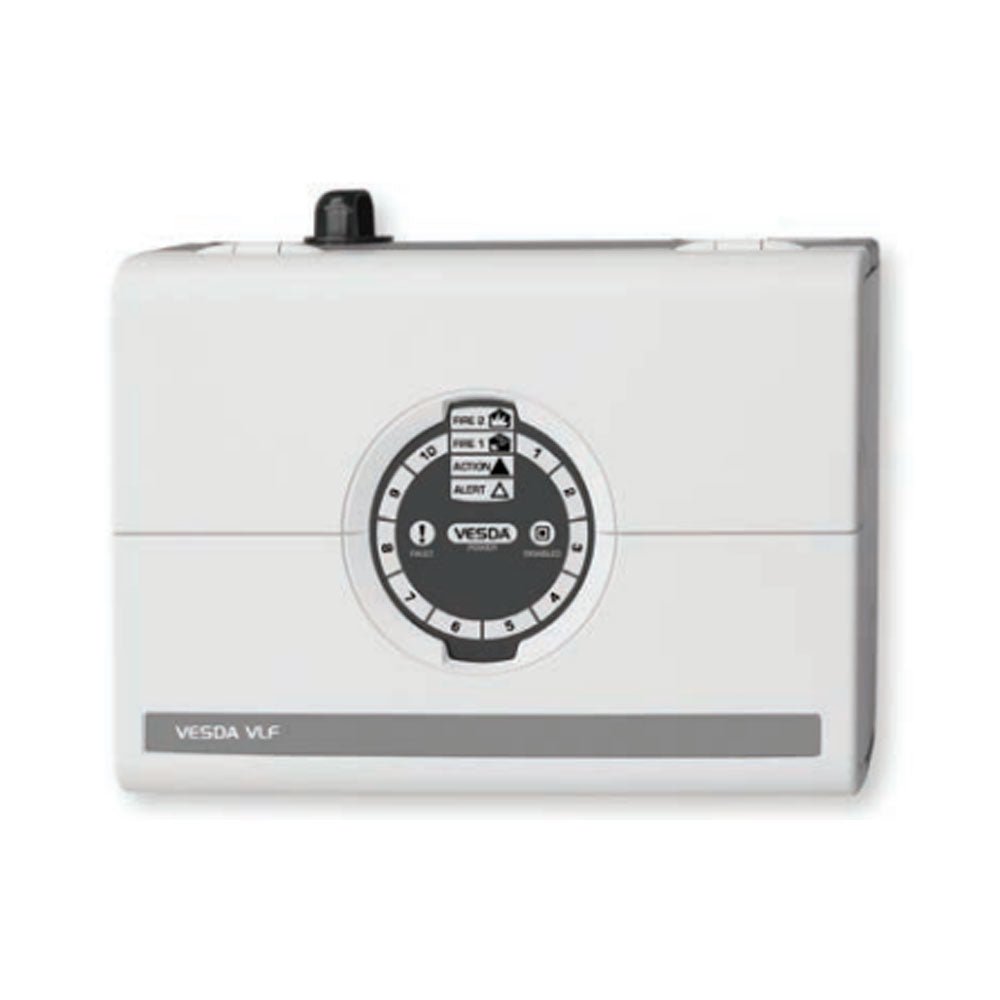
VLF-500-00-UL — UL-listed VESDA LaserFOCUS aspirating smoke detector for business-critical spaces up to 5,380 sq ft (500 m²), European language set with English display labels.
The detector continually draws air through sampling holes in a pipe network, filters it, and passes it into a laser detection chamber where light scattering reveals very small quantities of smoke. Status reaches the user on the Smoke Dial display and through three changeover relays or an optional interface card. The UL variant is documented against UL 268 7th edition, whose nuisance-alarm requirement changes how the Fire 1 threshold must be set — see the installation notes below. Behind the field service door, the 10-sector Instant Fault Finder converts the Smoke Dial into a numbered fault readout so the specific fault is known before a service call is placed.
Specifications
| Order code |
VLF-500-00-UL — European language set, English display labels |
| Supply voltage |
24 VDC nominal (18 to 30 VDC) |
| Power consumption at 24 VDC |
9.8 W nominal, 11.7 W in alarm |
| Current consumption at 24 VDC |
410 mA nominal, 490 mA in alarm |
| Dimensions (W x H x D) |
10-1/16 in x 7-1/5 in x 3-2/3 in (256 mm x 183 mm x 92 mm) |
| Weight |
Approx. 4.4 lb (2 kg) |
| IP rating |
IP30 |
| Mounting |
Upright, inverted or horizontal with appropriate mounting bracket |
| Operating conditions |
Detector ambient 32°F to 103°F (0°C to 39°C); tested to (EN 54-20) 14°F to 131°F (-10°C to 55°C); sampled air -4°F to 140°F (-20°C to 60°C); humidity 5% to 95%, non-condensing |
| Area covered |
5,380 sq ft (500 m²) |
| Air inlet pipe |
IPS 3/4 in (OD 1.05 in) or OD 25 mm (ID 21 mm); alternate pipe sizes can be modelled with ASPIRE |
| Single pipe length |
150 ft (50 m) max — 5 to 8 sampling holes pre-engineered, 9 to 24 holes modelled with ASPIRE |
| Two-branch pipe length |
90 ft (30 m) max per branch — 3 to 6 holes per branch pre-engineered, 7 to 12 modelled with ASPIRE |
| Return air sampling (U-shaped, per branch) |
8 to 14 holes pre-engineered, 9 to 24 modelled with ASPIRE |
| Field wiring access |
3 x 25 mm (1 in) cable entries, one rear entry |
| Terminals |
30 to 12 AWG (0.2 mm² to 2.5 mm²) |
| Interfaces |
Power in/out; Fire 1, Action and Fault changeover relays each rated 2 A at 30 VDC; general purpose input (clean contact); external display port with power limited output; RS232 programming port |
| Alarm ranges |
Alert and Action 0.008 to 0.625% obs/ft (0.025 to 2.0% obs/m); Fire 1 and Fire 2 0.008 to 6.25% obs/ft (0.025 to 20% obs/m) |
| Alarm delays and threshold sets |
0 to 60 seconds individually; two threshold sets, day and night |
| Display |
4 alarm state indicators; fault and disabled indicators; 10-sector smoke level indicator; 10-sector Instant Fault Finder; reset, disable and test controls; smoke and flow AutoLearn controls and indicators |
| Event log |
Up to 18,000 events with date and time stamp — smoke trend, flow trend, fault, configuration and operational events |
| AutoLearn smoke and flow |
Minimum 15 minutes, maximum 15 days, default 14 days |
| Laser safety |
Class 1 laser product |
| Product listings |
UL, CSFM, FDA, CE, FCC, RCM |
Installation notes
-
UL 268 7th edition changes threshold design: the standard adds a nuisance alarm requirement, so at every sampling port the Fire 1 threshold must sit above the nuisance smoke level and below the smoke alarm level. The pipework must be analysed so a single detector threshold satisfies both criteria at every port. Alert, Action and Fire 2 are not subject to that requirement.
-
AutoLearn Smoke is disabled in UL 268 Ed7 Open Area mode because it may calculate sensitivities that exceed the standard's nuisance smoke limit. Plan on a designed threshold, not a learned one, in that mode.
-
Pre-engineered designs stop early: a single pipe is pre-engineered only to 8 holes and a branch to 6 per branch. Anything beyond that must be modelled in ASPIRE.
-
Return air grille sampling: recommended coverage is 4 sq ft (0.4 m²) per sampling hole, and holes should be rotated roughly 45° away from the incoming airflow and toward the grille surface to reduce the risk of a Low Flow Fault when the air handling unit stops.
-
Approvals differ from the non-UL VLF-500, whose data sheet lists ULC, FM, LPCB, VdS, VNIIPO, AFNOR, ActivFire and EN 54-20 classification. Do not carry those claims onto the UL variant.
-
Consumables: filter cartridge VSP-005; the aspirator for the VLF-500-UL is VSP-715, not the VLF-250's VSP-722.
Related models
-
VLF-500-02-UL — the same UL detector with international display labels and the English plus Asian language set.
-
VLF-500-00 — the non-UL VLF-500, same hardware envelope but a different approvals set including EN 54-20 classification.
-
VLF-250-00 — smaller LaserFOCUS rated to 250 m² with a 25 m pipe and 12 holes.
-
VIC-010 / VIC-020 / VIC-030 — VESDAnet Interface Card and Multifunction Control Cards for the VLF range.
Specifications taken from the Xtralis (Honeywell) "VESDA VLF-500-UL Product Guide," document 36286_A2, part number AD36286-001 (August 2021). Manufacturer specifications are subject to change without notice.