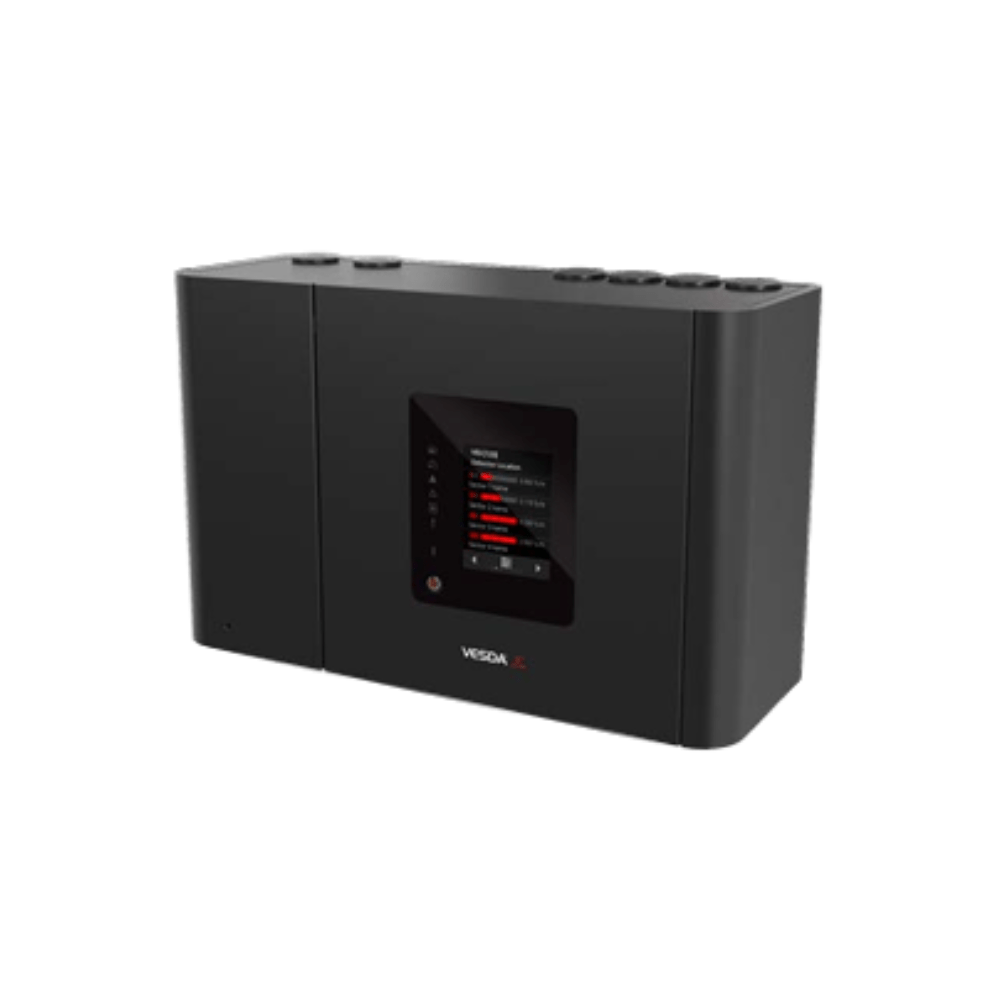
VES-A10-P — VESDA-E VES sector-addressable aspirating smoke detector, four pipes, 3.5 in display, plastic enclosure.
The VES takes the flagship VESDA-E VEP and adds a valve mechanism in the inlet manifold, plus the software to control airflow from each of the four pipes. That turns one detector into four independently reported sectors — separate aisles within a data room, for example. In normal operation the VES draws from all sectors at once; when smoke reaches the Adaptive Scan Threshold it scans each sector quickly to find which is carrying it. The first sector to reach Alert becomes the First Alarm Sector; if two or more reach Alert together, the sector with the highest smoke concentration takes that designation. Once the fast scan completes, the detector keeps monitoring all four sectors to track fire growth and maintain full coverage. Four alarm levels are configurable per sector. The display's home page carries a smoke level bargraph and the adaptive scan threshold; when that threshold is exceeded it switches automatically to the sector status page, and only returns to home under user control.
Specifications
| Order code |
VES-A10-P — VESDA-E VES with 3.5 in display, plastic enclosure |
| Supply voltage |
18 to 30 VDC (24 V nominal) |
| Power consumption at 24 VDC |
Aspirator setting 1: 8.6 W quiescent, 9.4 W alarm. Setting 5: 10.5 W quiescent, 10.8 W alarm. Setting 10: 15.4 W quiescent, 15.2 W alarm |
| Dimensions |
350 mm x 225 mm x 135 mm (13.8 in x 8.9 in x 5.3 in) |
| Weight |
4.4 kg (9.7 lb) |
| Operating conditions |
Ambient 0°C to 39°C (32°F to 102°F); tested to EN 54-20 -10°C to 55°C (14°F to 131°F); sampled air -20°C to 60°C (-4°F to 140°F); humidity 5% to 95% RH, non-condensing. UL listed for use from 0°C to 38°C (32°F to 100°F) |
| Area coverage |
2,000 m² (21,520 sq ft) |
| Minimum airflow per pipe |
20 l/m |
| Pipe length |
280 m (919 ft) linear; 560 m (1,837 ft) branched |
| Pipe length by pipes in use |
2 pipes 100 m (328 ft); 3 pipes 80 m (262 ft); 4 pipes 70 m (230 ft) |
| Sampling holes (Class A/B/C) |
40 / 80 / 100 |
| Pipe inlet and exhaust |
External diameter 25 mm or 1.05 in (3/4 in IPS); exhaust via adaptor |
| Relays |
12 programmable relays, latching or non-latching; contacts rated 2 A at 30 VDC (resistive) |
| IP rating |
IP40 |
| Cable access |
4 x 26 mm (1.02 in) cable entries |
| Cable termination |
Screw terminal blocks 0.2 to 2.5 sq mm (24 to 14 AWG) |
| Dynamic range |
0.001% to 32% obs/m (0.0003% to 10% obs/ft) |
| Sensitivity range |
0.005 to 20% obs/m (0.0016% to 6.25% obs/ft) |
| Threshold setting range |
Alert 0.005% to 2.0%; Action 0.005% to 2.0%; Fire 1 0.010% to 2.0%; Fire 2 0.020% to 20.0% obs/m |
| Event log |
Up to 20,000 events, time and date stamped |
| Design tool |
ASPIRE |
| Listings and approvals |
UL, ULC, CSFM, ActivFire, VdS, EN 54-20 / ISO 7240-20 |
| EN 54-20 hole classification |
Class A: 40 holes, Fire 1 = 0.067% obs/m. Class B: 80 holes, Fire 1 = 0.085% obs/m. Class C: 100 holes, Fire 1 = 0.251% obs/m. Classification of any configuration is determined using ASPIRE |
Installation notes
-
Higher minimum airflow than a VEP: the VES needs 20 l/m per pipe where the VEP needs 15 l/m. A pipe network carried over from a VEP design will not necessarily satisfy the VES.
-
Two pipes is the practical floor: the published per-pipe length table starts at two pipes in use (100 m each), falling to 80 m at three pipes and 70 m at four. The VES is a multi-sector product; a single-pipe application belongs on a VEP.
-
The data sheet flags several pipe figures as subject to agency confirmation — linear and branched pipe lengths and the A/B/C hole counts. Confirm against the current approvals matrix before committing a design.
-
Sectors are pipes, not points: addressability resolves to one of four sampling pipes. Per-sampling-point location is the VEA product line.
-
Display behaviour on alarm: the sector status page appears automatically when the adaptive scan threshold is exceeded and only returns to the home page under user control, so a screen left on sector status is expected after an event rather than a fault.
-
Retrofit footprint: the VES occupies the same mounting footprint and pipe, conduit and electrical connector positions as the legacy VESDA VLS.
Related models
-
VES-A00-P — the same sector-scanning detector with an LED fascia; lower quiescent draw at every aspirator setting.
-
VES-A10-P-UL — the UL-listed variant; its product guide publishes 10.6 lb (4.8 kg) and a 0°C to 38°C ambient, and a listings set of UL, ULC, CSFM, FDA, FCC and RCM rather than VdS and EN 54-20.
-
VEP-A10-P — four-pipe VESDA-E with the same 3.5 in display but no sector addressability, 7 relays instead of 12, and a 15 l/m minimum airflow.
-
VSP-955 — VESDA-E VES scanner manifold spare, the assembly that makes sector scanning possible.
-
VSP-969-S — front cover, plastic, for the VES-A10-P 3.5 in display.
Specifications taken from the Xtralis (Honeywell) data sheet "VESDA-E VES," document VESDA-E-VES V.01 (April 2020). Manufacturer specifications are subject to change without notice.