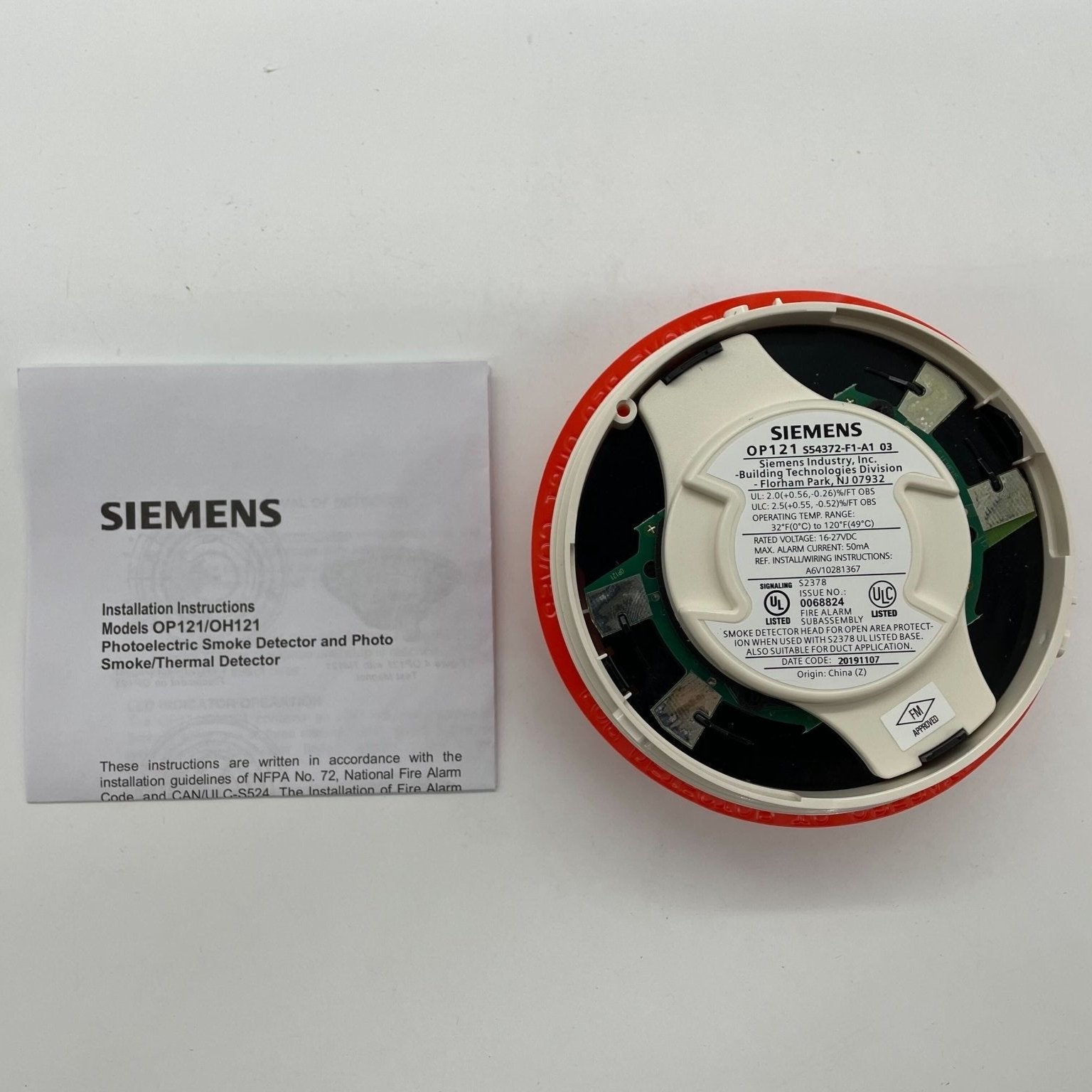
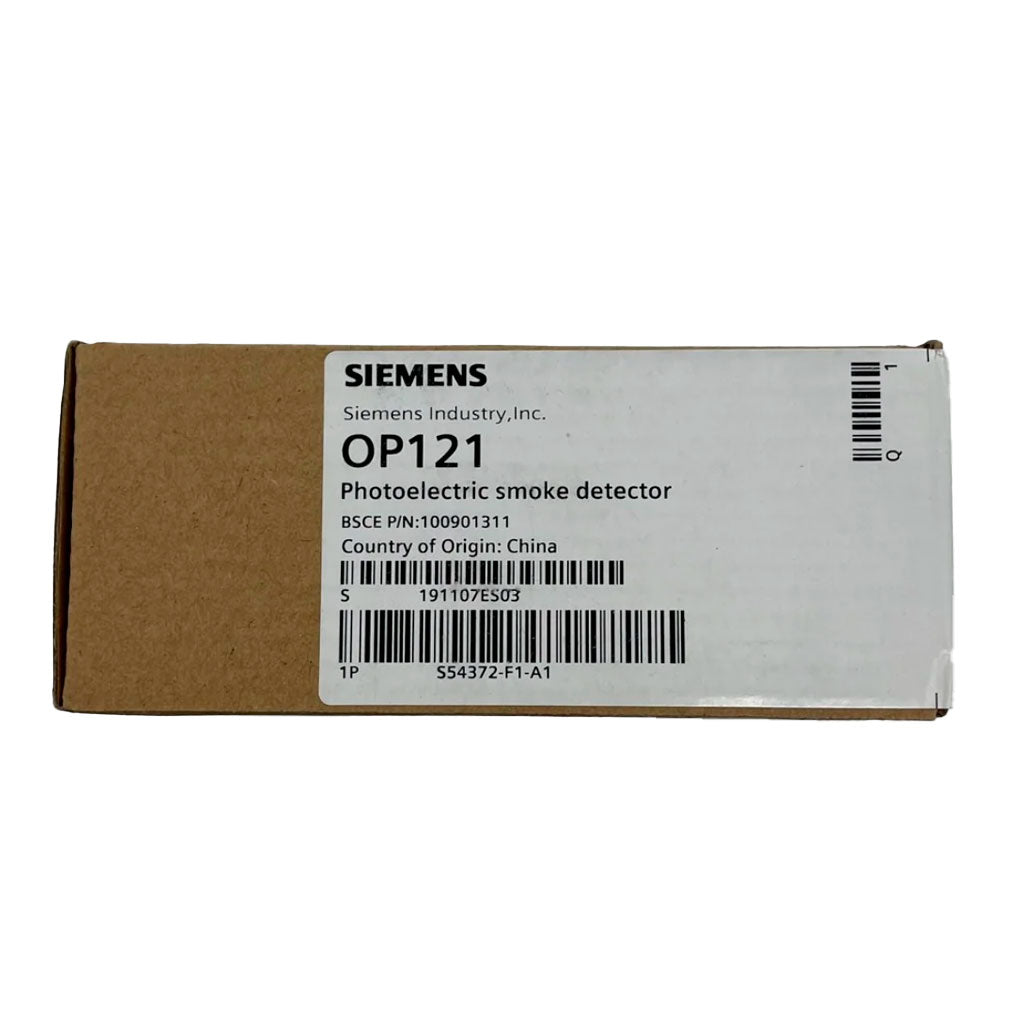
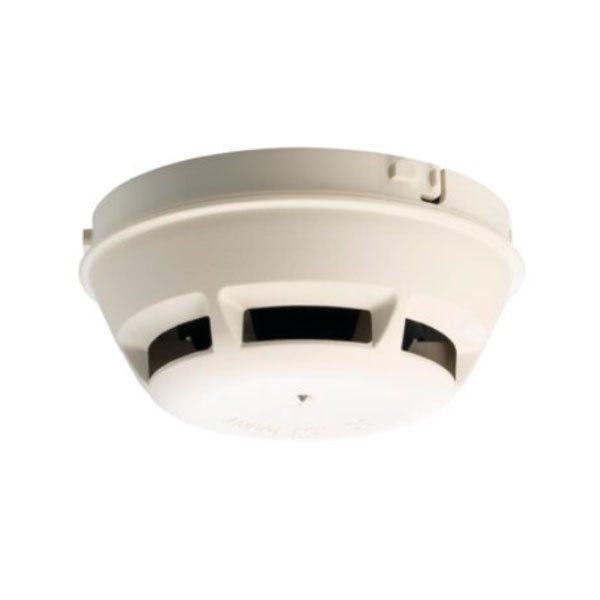
Siemens OP121 (stock no. S54372-F1-A1) is a conventional photoelectric smoke detector with microprocessor-controlled, self-diagnostic circuitry. Its automatic sensitivity test meets NFPA 72 without a separate sensitivity tester, and a three-color LED on the detector shows normal, trouble and alarm status. A magnet test lets installers prove the wiring and the connection to the fire alarm control panel.
The detector uses an infrared LED and an infrared photodiode in a smoke chamber designed to manage light from dust and other non-smoke contaminants. It is UL 268 certified for open-area protection and UL 268A certified for direct in-duct use, with ULC 529, FM and CSFM approvals.
Specifications
| Model / part no. |
OP121 / S54372-F1-A1 |
| Detection |
Photoelectric (infrared LED and photodiode) |
| Voltage |
16 to 27 VDC; 3 V peak-to-peak ripple |
| Supervisory current |
500 µA |
| Alarm current |
50 mA |
| Start-up time |
30 seconds maximum |
| Sensitivity |
1.71 to 2.8 %/ft (nominal 2.3 %/ft) |
| Air velocity |
0 to 4000 ft/min (open area and in-duct) |
| Operating temperature |
32°F to 100°F (0°C to 38°C) |
| Humidity |
0 to 95% non-condensing |
| Certifications |
UL 268, UL 268A, ULC 529; FM and CSFM approved |
LED indications
- Green flash every 10 seconds: normal supervisory operation
- Yellow flash every 5 seconds: detector in trouble, needs replacement
- Red flash every 2.5 seconds: alarm
- No flash: detector not powered or requires repair
Related models
- OH121 (S54372-F2-A1): photo/thermal smoke detector
- HI121 (S54372-F3-A1): thermal detector
- DB-11 and DB-11E: detector bases
- FDBZ492 series: air-duct housings
- TM121: test magnet
Documents
FAQ
Which base does the OP121 use?
Siemens lists the DB-11 low-profile surface-mount base and the DB-11E smaller-diameter base; in Canada use the DB-11C.
Can it be used in an air duct?
Yes. It is UL 268A certified for direct in-duct use and works with the FDBZ492 series air-duct housings, at air velocities up to 4000 ft/min.
Do I need a sensitivity tester?
No. The automatic sensitivity test meets NFPA 72 without special test equipment, and the three-color LED shows the result.
What do the LED colors mean?
Green every 10 seconds is normal, yellow every 5 seconds means the detector is in trouble and needs replacement, and red every 2.5 seconds is alarm.