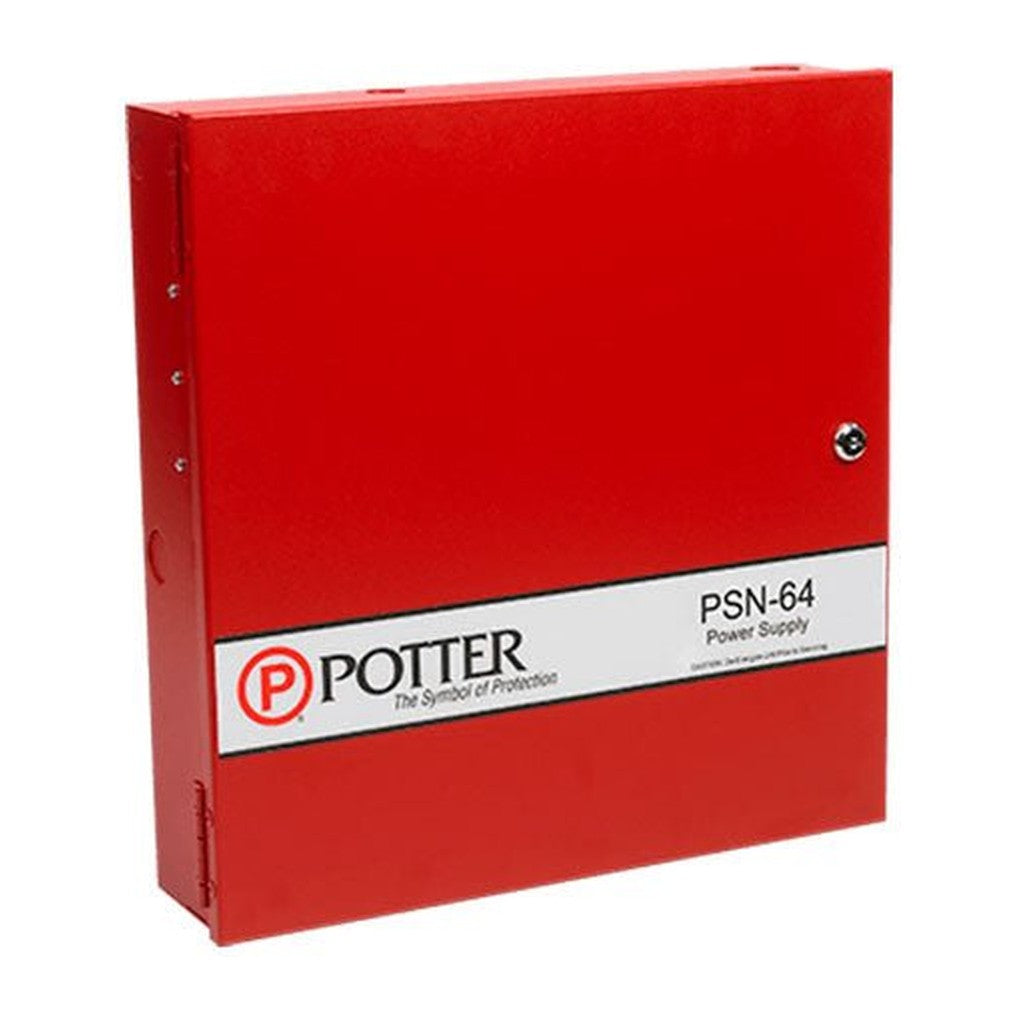
When a fire alarm panel runs short of notification power, the Potter PSN-64 adds 6 amps of continuous power across four outputs. Each output is rated at 3 amps and can be used continuously without derating. This PSN Series notification power supply serves both new installations and retrofits.
Key Features
- 6 A of regulated 24 VDC power across 4 outputs, 3 A per output with no derating
- Quadrasync synchronizes AMSECO, Gentex, Wheelock and System Sensor strobes, with each output set independently
- Pass Thru mode lets outputs follow the input signal from the FACP
- Each output can be set for Class A or Class B, constant power, ANSI Temporal Code 3 or door holder power
- Two trouble relays (general system trouble and low AC) and diagnostic LEDs with trouble memory
- Lockable 18-gauge steel cabinet in red powder coat
Specifications
-
Manufacturer: Potter
-
Part Number: PSN-64
-
Output: 6 A total, regulated 24 VDC; 4 NAC outputs, 3 A max. each
-
Power Input: 120 VAC @ 60 Hz or 220/240 VAC @ 50 Hz
-
Input Trigger: 15 mA @ 8–33 VDC
-
Trouble Relays: 5 A @ 30 VDC
-
Battery Charging: 27.3 V @ 1 A; supports 7–55 Ah batteries
-
Operating Temperature: 32°F to 120°F (0°C to 49°C), 93% max. humidity non-condensing
-
Terminals: 18–12 AWG
Compatibility
Can be connected to any manufacturer's UL 864 certified FACP for activation and supervision. Accepts a reference EOL of 2K to 27K ohms.
Documents
FAQ
Can the PSN-64 be used with any brand of panel?
Yes. Potter states it may be connected to any manufacturer’s UL 864 fire alarm control panel for activation and supervision, and its reference EOL accepts 2K to 27K ohm values.
Can it sync strobes from different brands?
Yes. Quadrasync lets each output be set for AMSECO, Gentex, Wheelock or System Sensor sync, so different brands on separate circuits flash together.
What batteries does it support?
It charges at 27.3 V, 1 A and supports 7 to 55 Ah batteries; the cabinet houses up to 18 Ah batteries.
Can the outputs be Class A?
Yes. The outputs can be configured as Class A Style Z notification circuits, set by DIP switch per circuit.