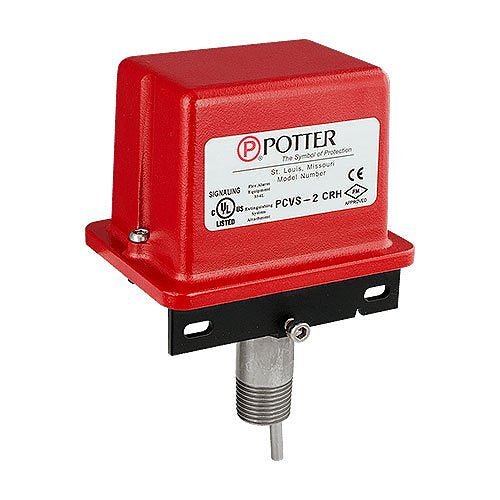
Potter PCVS-2-CRH (stock no. 1010211) — control valve supervisory switch, double switch, with corrosion-resistant 316 stainless steel hardware.
The PCVS is a weatherproof, tamper-resistant switch that monitors the open position of fire sprinkler control valves of the wall and yard post indicator and butterfly types. It mounts in a 1/2 in. NPT tapped hole in the valve housing and is engaged by the valve indicating assembly or operating mechanism. When the valve moves away from fully open, the spring-loaded trip rod operates two SPDT (Form C) contacts.
Specifications
| Contacts |
Two SPDT (Form C) |
| Contact rating |
10.0 A at 125/250 VAC; 2.0 A at 30 VDC resistive; 10 mA minimum at 24 VDC |
| Enclosure |
NEMA 4X (IP65) and NEMA 6P (IP67) with suitably rated conduit and connector |
| Hardware |
316 stainless steel (CRH model) |
| Operating temperature |
-40°F to 140°F (-40°C to 60°C), indoor or outdoor |
| Conduit entrances |
Two knockouts for 1/2 in. conduit |
| Weight |
1.0 lb (0.45 kg) |
| Service use |
NFPA 13, 13D, 13R, 72 |
Installation notes
- The cover is held by two tamper-resistant screws; the special tool is supplied with each device.
- Test by turning the valve toward closed: the switch must operate within the first two revolutions, must not restore while the valve is closed, and must restore when the valve is fully open again.
- Potter recommends testing quarterly or more often, per the authority having jurisdiction.
Related models
-
PCVS-2 (1010203) — same double switch with standard hardware.
Documents
FAQ
What is the difference between the PCVS-2-CRH and the PCVS-2?
The CRH model has corrosion-resistant 316 stainless steel hardware for additional protection of the mounting hardware. The switch and contacts are the same.
What valves does it monitor?
Wall and yard post indicator valves and butterfly valves, mounted in a 1/2 in. NPT tapped hole in the valve housing.
What are the contact ratings?
Two SPDT (Form C) contacts rated 10.0 A at 125/250 VAC and 2.0 A at 30 VDC resistive.
How is it tested?
Turn the valve toward closed; the switch must operate within the first two revolutions, stay in alarm while the valve is closed, and restore when the valve is fully open.