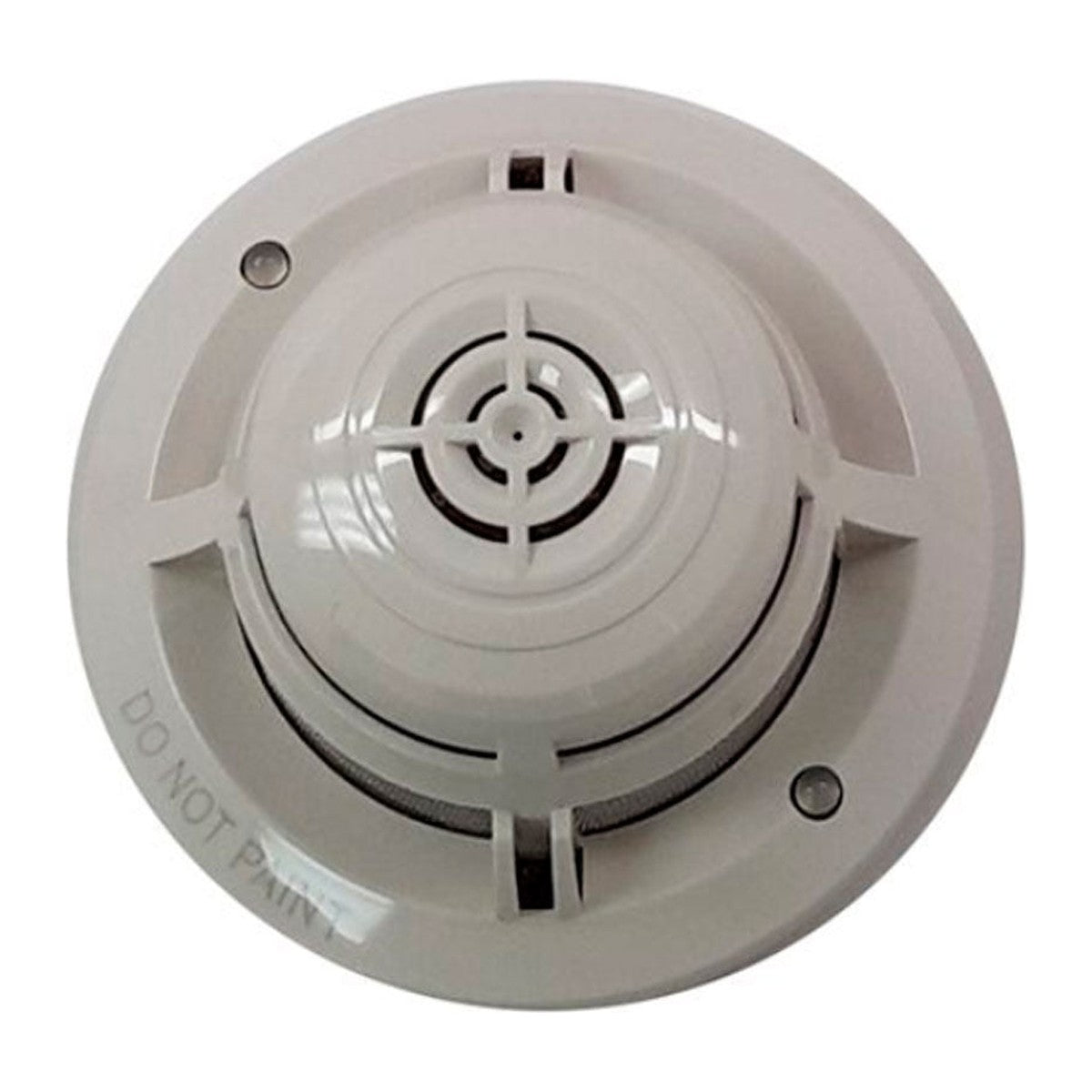
Notifier FCO-851 — IntelliQuad PLUS advanced multi-criteria fire/CO detector, a plug-in addressable device for FlashScan systems.
For fire, the FCO-851 combines four sensing elements in one unit (smoke, CO, light/flame and heat) for better sensitivity to real fires and higher immunity to nuisance particulate. Its electrochemical CO cell gives a separate signal for life safety carbon monoxide detection. It is certified to UL 268 for smoke detection and UL 2075 for system-connected CO monitoring, and uses only one SLC address.
Specifications
| Sensing |
Smoke, CO, light/flame (IR) and heat; separate CO signal |
| Protocol |
FlashScan only; CLIP mode not supported |
| Panels |
NFS-320, NFS-320SYS, NFS2-640 and NFS2-3030 with firmware 17.0 or higher |
| Sensitivity |
Levels 1–5: 1% to 4% per ft smoke; Level 6: 135°F (57°C) thermal |
| Size |
3.46 in. high x 6.875 in. diameter in a B200S base |
| Color |
Ivory |
| Weight |
4.6 oz (130 g) |
Features
- Automatic drift compensation of smoke sensor and CO cell
- RealTest CO testing capability
- CO cell end-of-life warning and fault
- With the B200S sounder base, Temporal 3 for fire and Temporal 4 for CO
Installation notes
- Use with the B200S intelligent sounder base (B200SCOA in Canada) for separate fire and CO tones.
- After CO cell end-of-life, the detector keeps fire detection in Photo, Thermal, Infrared (PTIR) mode, but no longer provides CO protection.
Documents
FAQ
Which panels support the FCO-851?
The NFS-320, NFS-320SYS, NFS2-640 and NFS2-3030 running firmware 17.0 or higher in FlashScan mode. CLIP mode is not supported.
Which base should be used?
The B200S intelligent sounder base (B200SCOA in Canada), which gives Temporal 3 for fire and Temporal 4 for CO.
What happens when the CO cell reaches end of life?
The detector signals the end of life. It then stops providing CO protection but continues fire detection in Photo, Thermal, Infrared (PTIR) mode.
How many SLC addresses does it use?
One address for both fire and CO detection.